This is the second part of my Gifted journal. The first part was about adolescence and the difficulty of believing I had much natural ability. This chapter is about what happened after that: a sequence of people, jobs and constraints that kept showing me a direction before I was ready to name it.
Looking back, my young adult years do not read like a plan. They read like a chain of encounters. Someone showed me a tool. A customer revealed a problem. A small company gave me room to attempt something. A relationship changed what I thought I needed to do next. What I once treated as luck now looks more like an education assembled from other people.
Learning design before calling myself a designer
During high school summers, when I was 17, I worked at Computer City with some older friends. Gus worked in the Apple department and loved Macintosh computers. Whenever I visited him upstairs, he showed me what he was making in Photoshop: dimensional type, metallic surfaces, liquid effects and all the visual tricks that made digital design feel new.
I could not afford a Mac, but access to Photoshop on Windows meant I could keep experimenting at home. Soon I was making flyers and posters for school clubs and helping customers at my parents’ printing shop with more finished designs. I still did not think of myself as an artist. I simply knew that I could learn a tool and use it to solve a real problem.
After Computer City closed, I worked full time at CompUSA. There I met Huy, who was a few years older, finishing college and consistently one of the store’s strongest salespeople. I had previously learned to sell by attaching every commissioned accessory I could to a purchase. Huy worked differently. He was direct about what customers needed and what they did not. Trust made him more effective than pressure.
I copied that principle and soon moved into corporate sales. The lesson stayed with me long after retail: the fastest transaction is not always the most valuable outcome. A customer who understands the recommendation is more likely to remember the person and company behind it.
At Linksys, support became product design
Many of my CompUSA coworkers were studying network administration, which seemed to offer a more stable future. I began studying management information systems at night and eventually joined Linksys in Irvine as a technical-support agent.
Support calls exposed a recurring problem. Networking guides across the category were dense with text, while novice customers needed to see what to click and what the equipment should look like. No one assigned me to redesign the documentation. I began making a screenshot-based guide because I wanted something clearer to use during calls.
I worked on it after the phones stopped ringing, often late enough that only a few people remained in the office. After roughly two months, I showed the guide to my manager, Tony Elahi. It traveled up the organization and reached Victor Tsao. Soon I was moved into marketing to apply the idea across products.

Marketing widened the work. I moved from user guides into websites, packaging and product decisions. I also learned from the people around me. Contractor Calvin Liu, who created Linksys illustrations and the original logo, let me watch his process. Copywriter Michael Calore taught me how language carries tone and how different styles change what a reader feels. Michael later built a long editorial career at WIRED, but to me he was first the colleague who made writing feel like a discipline I could study.
I eventually became a product manager and worked on the BEFW11S4, a consumer wireless router that needed to feel at home rather than in a server rack. The small, stackable form, paired antennas and two-tone blue identity made the product more approachable. Because the hardware had changed, I argued that its packaging and instructions should change with it.
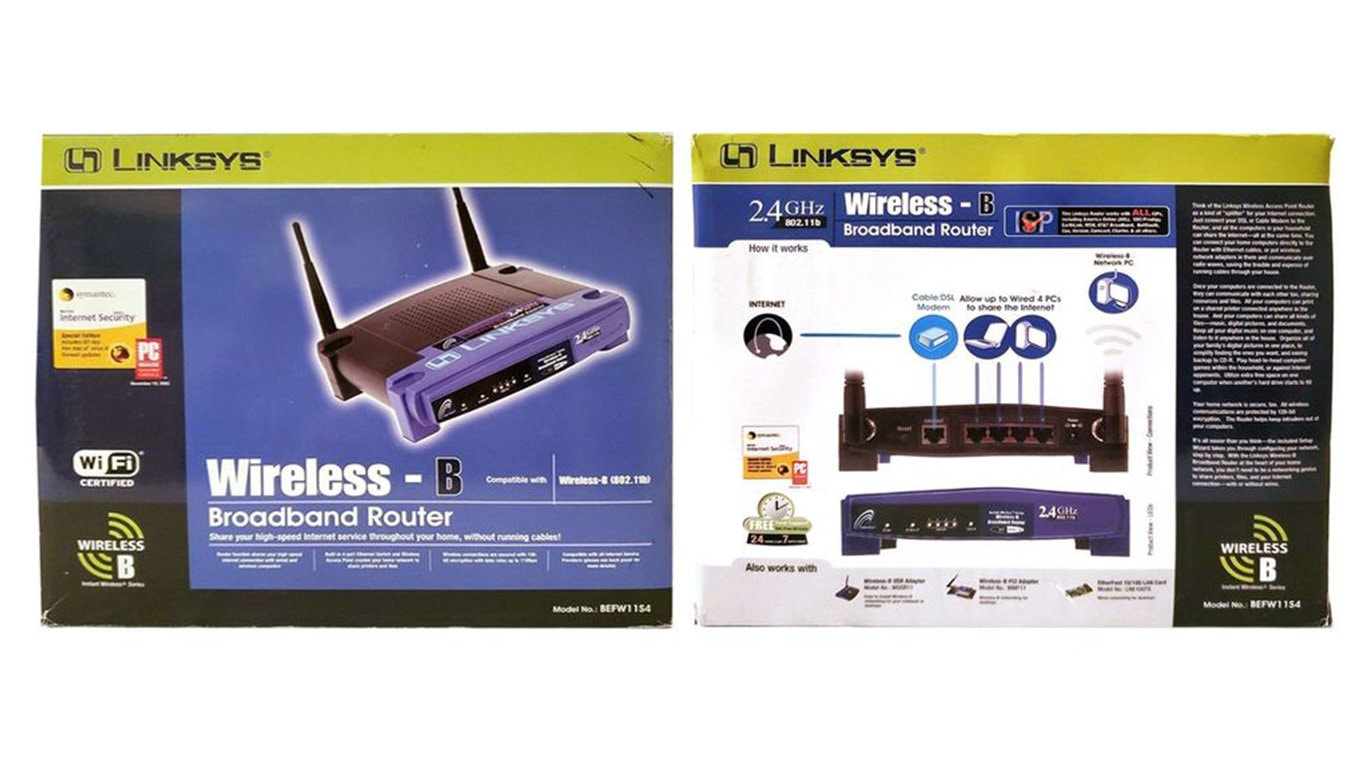
The most important part of that period was not one object. It was learning that a support document, a package and a physical product are connected expressions of the same promise. The customer does not separate the departments that produced them. They experience one brand.
I left Linksys before Cisco announced its agreement to acquire the company in 2003. I was young, my first son was on the way and I believed a degree offered the most reliable path forward. In retrospect, staying might have created other opportunities. That possibility is easy to imagine only because I already know what happened. At the time, I made the decision with the information and responsibilities I actually had.
Flash, Rare Medium and learning in public
I moved to San Francisco to study 3D design at the Academy of Art while working at CompUSA’s flagship store and sending money home. There I encountered Macromedia Flash at exactly the moment it was changing what people imagined a website could be.
I taught myself during lunch and after work. Within months, I was more interested in interactive web design than 3D modeling, so I left school and returned home. A junior MIS role at a law firm gave me room to keep studying. After about a year of practice, I joined Rare Medium as an associate designer creating Flash-based sites and interactive features for major clients.
At Rare Medium, Brandon Dove, Grant Hollis, Aaron Boodman and I were young enough to be called “The Kids.” We knew animation, but complex ActionScript was still beyond most of us. When an experienced team arrived from New York, I introduced myself and brought the others along. Their guidance expanded what we could build.
Aaron was the deepest experimenter among us. He studied the geometry behind radial interfaces and built knobs that changed hue and brightness. We explored fluid layouts that reorganized around the content in focus. Some experiments were practical; others existed simply to prove that an interaction was possible. Aaron did most of the programming, while I helped question, frame and visualize the ideas.
I am careful now about drawing a straight line from those experiments to what came later on the web. Many people were exploring related ideas. Their value to me was more personal: they taught me that learning could be collaborative, playful and ambitious even when the result never became a commercial product.
Rare Medium contracted as the internet bubble collapsed, and after about a year I was the last designer from my group to leave. The timing felt like another interruption. It became another turn.
Constraints at Crisp made me an illustrator
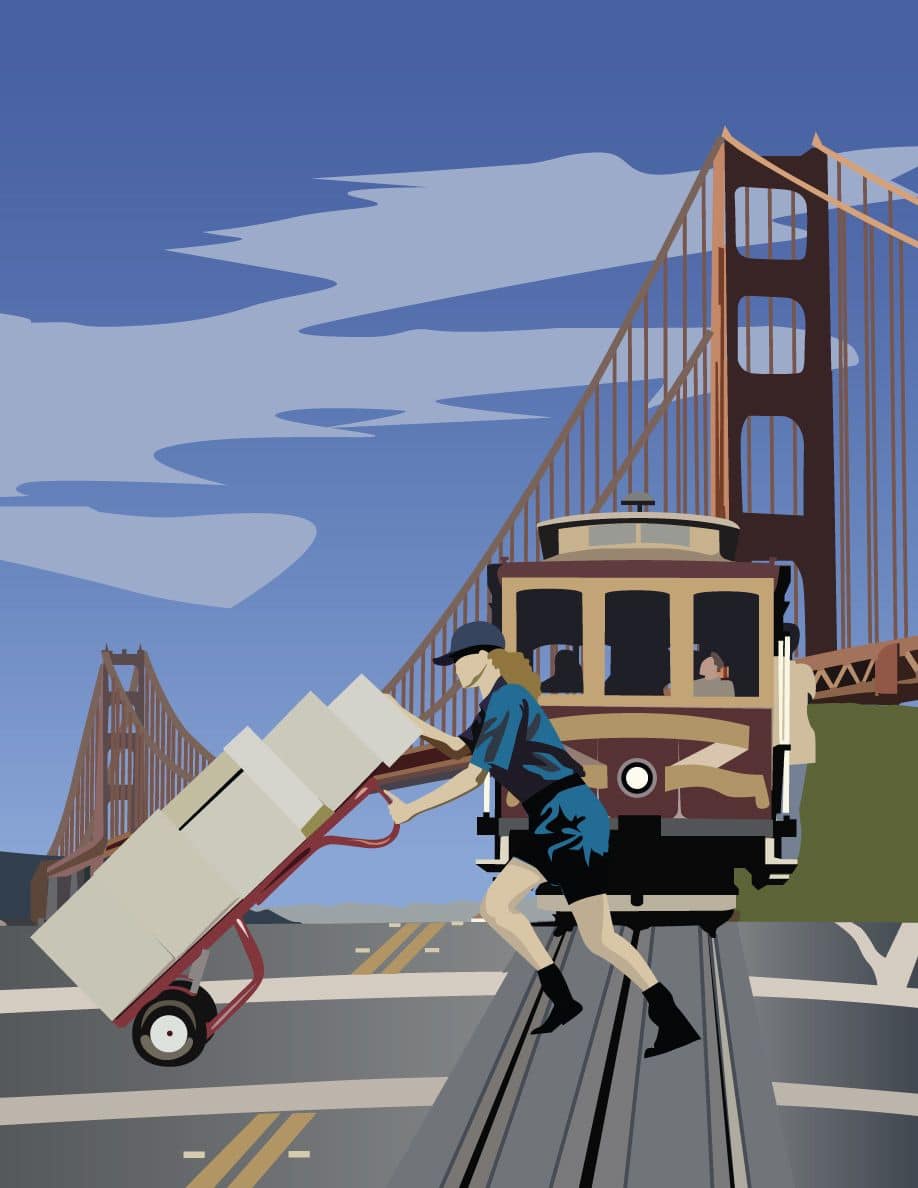
I joined Crisp Digital Brand Agency in Costa Mesa, a small shop serving clients whose ambitions were larger than their budgets. We could not always rely on expensive, perfectly matched photography. If a logistics company needed a specific scene, we had to find another way to make it.
I began tracing and layering reference images in Illustrator to build custom compositions. Environments were manageable; faces were not. For a while, the people in my illustrations were deliberately faceless. Then I practiced. Simple features became more believable, and over several years I learned to add expression, depth and light.

I had spent years assuming that real artists possessed something I did not. Crisp changed that belief. The company’s constraints forced me into the part of the work I had avoided, and the only route through it was repetition. What looked like a lack of talent was often a lack of time spent practicing the uncomfortable part.
Returning to school on my own terms
School was not an obvious next step. I was working full time and raising my son. My short experience at art school had reinforced the idea that I could teach myself through books and practice.
That changed when my girlfriend Juliee began community college. I read her assigned books so I could help with homework, then started taking some of the same classes. What began as support for someone else slowly became my own intellectual life.
English literature and the social sciences gave me language for questions I had already been asking through design: how people interpret signals, how groups create meaning and why some ideas move through culture. Social psychology was the turning point. I began planning for a sociology degree and treating school as something I had chosen rather than something being done to me.
For five years, I balanced work at Crisp, time with my son, and night and weekend classes. When I had enough credits to transfer, I was accepted by the University of Pennsylvania, Northwestern and the University of California, Irvine. Personal responsibilities and the need to keep my son near family made UCI the right decision. At 28, older than many of my classmates, I began my undergraduate studies.
What “gifted” came to mean
For a long time, I measured giftedness as effortless performance: doing well in school, drawing naturally or knowing early what you were meant to become. My own life did not fit that model.
Gus introduced me to Photoshop. Huy showed me that honest selling could outperform pressure. Support customers at Linksys revealed a communication problem. Tony and Victor gave an unsolicited guide room to become a role. Calvin let me watch an artist work. Michael taught me to study copy. The New York team at Rare Medium expanded our technical imagination. Juliee led me back toward a classroom. My son made every career decision more concrete.
None of those people handed me a finished path. They gave me a door, a question or a standard. I still had to step through, stay late, practice and make the next decision.
That is the form of giftedness I recognize now: not a talent that arrives complete, but the ability to notice an opening, learn from the people nearby and keep converting circumstance into capability.
