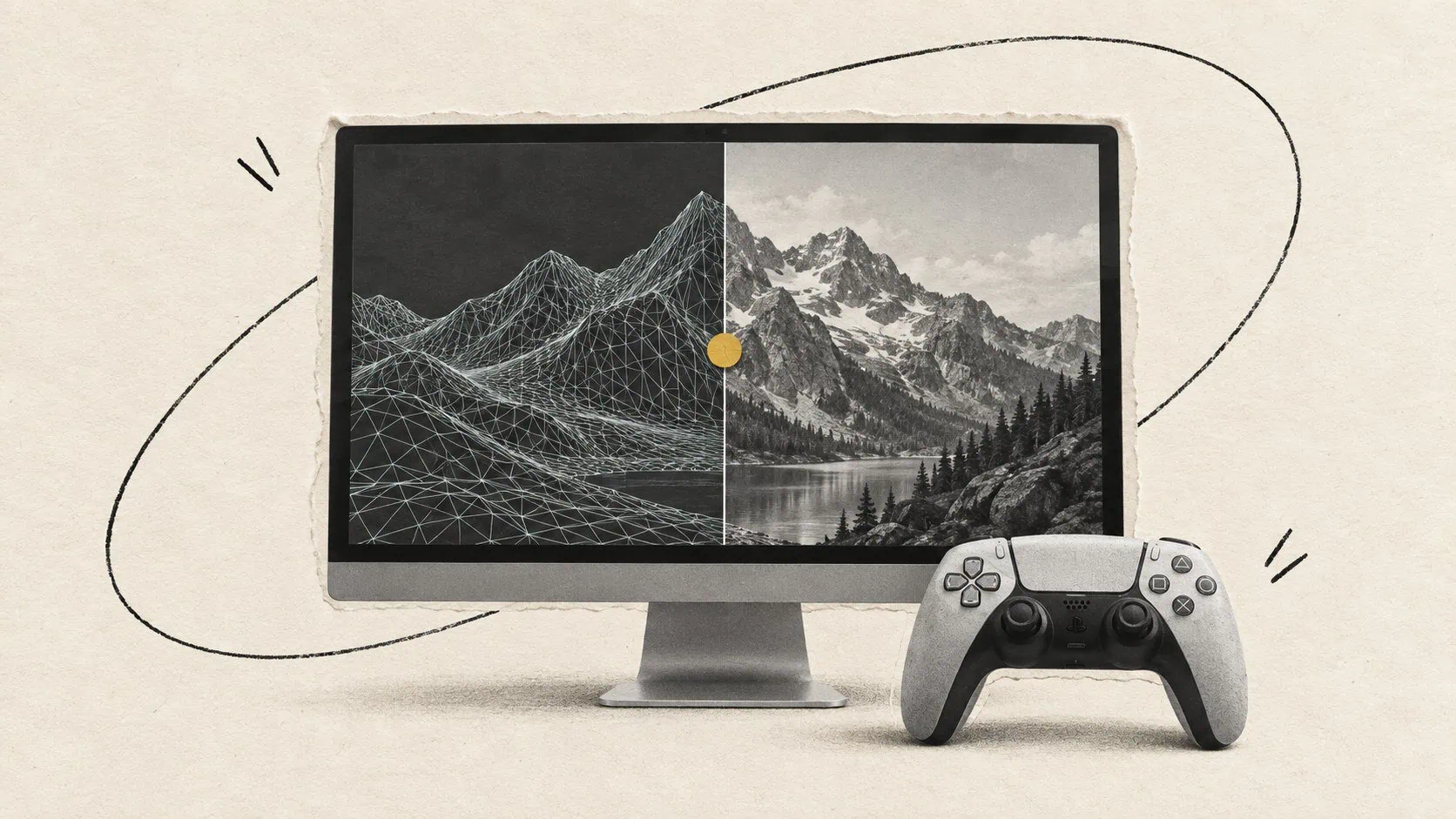
Gamers do not need another cinematic that says a product is powerful. They need to see what changed, why it matters and what conditions made the result possible. A modern tech demo should create wonder, but it should also leave enough evidence for the audience to trust the wonder.
This is the practical companion to my history of graphics technology demos. The old format is worth studying because it turned invisible capabilities into memorable scenes. Recreating it today does not mean bringing back a fairy mascot or a downloadable executable exactly as it existed twenty years ago. It means recovering the discipline beneath the spectacle.
There is no average gamer
I once described modern gamers as less technically literate than the enthusiasts I grew up around. That was too broad and not especially useful. Gaming now includes people who tune memory timings, people who care primarily about competitive latency, people who create worlds and mods, and people who simply want a game to run without thinking about the machine.
The marketing mistake is not assuming the audience knows too little. It is presenting every buyer with the same proof. A specification may be meaningful to an enthusiast and meaningless to someone deciding whether a new system will make a favorite game smoother. Both deserve accurate information; they need different entrances into it.
| Audience | The question behind the question | Useful proof |
|---|---|---|
| Competitive player | Will this help the game feel more responsive? | Frame-time, latency and consistency shown in a repeatable scenario. |
| Visual enthusiast | What can I see here that I could not see before? | A controlled scene with on/off comparison and close detail. |
| Mainstream buyer | Will this improve the games I actually play? | Recognizable use cases, clear settings and an honest before-and-after. |
| Creator or developer | Can I use this capability in my own work? | Project files, implementation notes, tools and performance constraints. |
Start with one claim, not a bag of effects
A strong demo can usually be summarized in one sentence: this light now reflects accurately, this character’s skin responds more naturally, this frame arrives faster, or this world can contain more detail. If the sentence needs five “and” clauses, the presentation probably has too many competing ideas.
The single claim determines the scene. Hair should move because the demo is about hair, not because a character with impressive hair happened to look good in a trailer. A crowded city should exist because the technology changes scale, simulation or geometry. The art direction should make the difference legible before it makes the frame beautiful.

Design the proof in layers
One asset cannot serve every audience and channel. I would build a contemporary demonstration as a small proof system:
- The moment: a short hero sequence that makes the capability emotionally clear without trying to explain everything.
- The comparison: a locked camera, toggle or split view that shows exactly what changes when the feature is enabled.
- The explanation: a guided breakdown connecting the visible difference to the underlying technology in plain language.
- The evidence: hardware, resolution, settings, build, driver, frame rate and capture method displayed where people can find them.
- The experience: when practical, a downloadable project, benchmark or playable slice that lets other people reproduce part of the result.
The short film earns attention. The comparison turns the claim into something observable. The explanation teaches. The metadata establishes the boundaries. The interactive layer converts spectators into participants. A viewer can stop at the level that answers their question without forcing everyone through the same presentation.
Show the conditions, including the inconvenient ones
A controlled demo is allowed to be ambitious. It is not allowed to hide what it took to run. “Real time” is incomplete without context. The audience should be able to find the GPU and CPU, target resolution, quality preset, frame rate or frame-time range, upscaling and frame-generation settings, software build and whether the footage was captured live or edited from a live run.
That disclosure does not weaken the magic. It protects it. Enthusiasts will investigate the missing detail anyway, and a discovery that feels concealed can become the entire conversation. If a new effect costs performance, show the cost and the benefit together. If an optimized mode depends on reconstruction, describe it. Confidence is more persuasive than pretending there is no tradeoff.
Give the audience something to do
The old downloadable demos made the hardware personal. People changed camera angles, moved lights, adjusted sliders and tried to make the system fail. The interaction was limited, but it turned a claim into a small discovery.
That spirit can live in many forms now: an on/off web comparison, a benchmark with transparent presets, a creator scene with exposed controls, a guided livestream, a playable level or a game demo. Valve’s current Steamworks guidance treats demos as small playable portions that should be high quality, representative and long enough to create interest without pretending to be the entire game. The same discipline applies to hardware demonstrations: choose the smallest experience that proves the important thing.
When distribution or hardware requirements make a public build impractical, invite credible reviewers and creators to operate it. Give them the scene, instructions and disclosure requirements, then let them test beyond the rehearsed path. Independent exploration produces evidence a brand-controlled video cannot.
Build for scrutiny, not only launch day
Gaming audiences pause frames, compare versions, inspect overlays and remember promises. That behavior should shape production from the beginning. Preserve clean captures, raw comparisons, downloadable stills and a plain-language technical sheet. Make the difference visible on a phone without removing the full-resolution evidence enthusiasts want on a monitor.
Localization matters too. Put essential labels in the interface rather than burying them in spoken narration. Caption the video. Avoid communicating the difference through color alone. Provide a static comparison for people who cannot or do not want to load motion. Accessibility is part of proof because a demonstration that cannot be perceived cannot persuade.
A modern demo brief
| Decision | Question to answer before production |
|---|---|
| Capability | What new behavior can the audience see or feel? |
| Audience | Who needs emotional context, technical depth or hands-on access? |
| Scene | What environment makes the change obvious without stacking unrelated effects? |
| Comparison | What remains controlled so the before-and-after is fair? |
| Disclosure | Which hardware, settings, software and capture conditions must accompany the claim? |
| Participation | Can the audience toggle, download, play, inspect or reproduce the result? |
| Distribution | How will the proof adapt to stage, long video, short social, retail and editorial use? |
| Measurement | Will success mean completion, interaction, download, qualified traffic, wishlists or purchase? |
I would also put one person in charge of claim integrity. Their job is to compare every line of copy and every edited shot against what the actual build can reproduce. The FTC’s advertising guidance is a useful baseline: marketing claims should be truthful, not misleading and supported by evidence. A technical audience expects at least that much before the law enters the conversation.
Measure whether people understood the difference
Views tell you that the opening attracted attention. They do not tell you whether the demonstration worked. I would watch what people do next: activate the comparison, change a control, expand the technical details, finish the guided breakdown, download the build, visit a supported-product page or ask a question that shows they understood the feature.
The comments are also research. If everyone debates whether the footage is pre-rendered, disclosure failed. If they admire the character but cannot name the capability, the art overwhelmed the claim. If enthusiasts reproduce the result and begin experimenting beyond the official scene, the demo has become a platform for conversation rather than a disposable launch asset.
The goal is not to impress gamers. It is to respect their curiosity.
The most valuable lesson from classic GPU demos is not that gamers love shiny graphics. It is that a technology becomes exciting when people can connect a technical change to a visible possibility. The presentation should reward a casual viewer with a clear moment and an expert with enough information to interrogate it.
Marketing to gamers works when the brand knows what it is proving, makes the proof memorable and leaves the seams visible. Awe gets attention. Specificity and honesty turn that attention into trust.