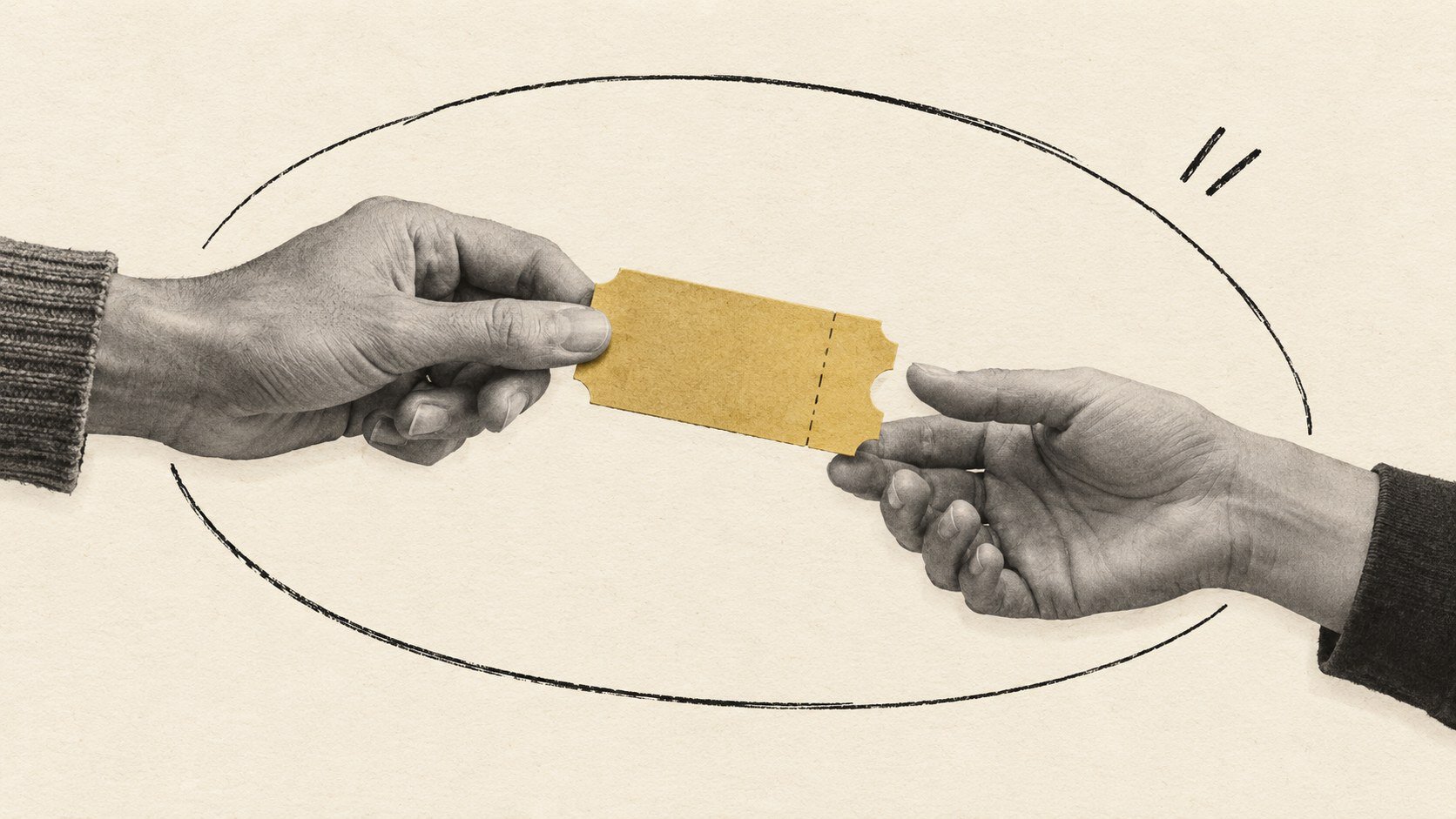
When a friend asks for professional help, the hard part is rarely the work itself. The hard part is protecting the relationship while still respecting the time, judgment and responsibility the work requires.
As a branding and marketing professional, I have been asked many times to help friends, relatives and friends of relatives with logos, campaigns and business ideas. Saying yes can feel generous. It can also create an arrangement in which nobody is quite sure what was promised, when it will be ready or how many times it can be revised.
My answer became what I call the one-time coupon: one meaningful piece of work, offered as a gift, with a clear beginning and a clear end. It is not a trick for avoiding generosity. It is a way to make generosity sustainable.
A favor still needs a scope
Informal work often goes wrong because both people rely on goodwill instead of definition. The person asking may imagine a finished identity system. The designer may imagine one logo direction. “Whenever you have time” can quietly become “Why is this taking so long?” A request for a small change can become an open invitation to keep revising.
Before I accept, I try to name the deliverable in ordinary language. It might be one logo concept, one landing-page recommendation, one review of an existing deck or one strategy conversation followed by written notes. I also say what is outside the gift: additional directions, production files, vendor management, ongoing meetings or repeated revisions. A boundary does not make the offer less kind. It makes the offer understandable.

What the coupon actually includes
My original version was simple: I would give someone one free pass, spend the time necessary to make the work thoughtful and deliver one final product. They could use it, build on it or take it to someone else. What they were not buying was unlimited access to me until every uncertainty disappeared.
| Define | What I clarify |
|---|---|
| Outcome | The one thing I will deliver. |
| Inputs | The information, files and decisions I need from them. |
| Timing | A realistic window, with the understanding that paid and full-time responsibilities come first. |
| Feedback | Who gives it and whether one consolidated response is included. |
| Rights and files | What they may use, what source files they receive and whether portfolio use is appropriate. |
| Finish line | The point at which the gift is complete and further work becomes a new arrangement. |
I do not need a fifty-page contract to explain a small gift, but I do want the agreement written down. A short email can prevent two sincere people from remembering the same conversation differently. For a larger, paid or legally sensitive engagement, friendship is not a substitute for a proper professional agreement and appropriate legal or tax advice.
Price is not the first boundary
When I first wrote about this method, my standard rate for new clients was roughly $300 to $350 an hour, and I sometimes used about $200 an hour as a friends-and-family rate. Those were my numbers at that point in my career, not a formula other people should copy. Rates change with experience, demand, geography, risk and the kind of work being requested.
The important distinction is between a gift and a discount. A gift has a fixed edge: this is the thing I am giving you. A discount is still a professional engagement. It should have a scope, price, schedule, revision policy and payment terms. Confusing the two creates the worst of both arrangements: professional expectations with none of the professional structure.
A free project should not become lower-quality work
I use the coupon when I genuinely want to help and believe I can contribute something valuable. Once I say yes, I do not treat the work as disposable. In some ways, removing the hourly clock gives me room to think without making the recipient pay for every difficult turn in the process.
That freedom only works because the output is limited. I can put real care into one considered answer. I cannot promise that the recipient will love it, and I cannot keep producing alternatives until the result matches an idea they have not yet articulated. The gift is my best judgment, not a guarantee of endless agreement.
Know when the answer should be no
Some requests are too large for a coupon. A full identity, website, ecommerce system or launch campaign can create continuing obligations long after the first files are delivered. Some projects require expertise, insurance, research, compliance or production support that should not be improvised as a favor. And sometimes I simply do not have the time or emotional space to do good work.
In those cases, saying no early is kinder than saying yes resentfully. I can still help by recommending a specialist, narrowing the request, reviewing a brief or explaining what a realistic budget should include. Help does not always have to mean taking ownership of the project.
If the work continues, reset the relationship
Sometimes the first deliverable reveals that there is a real project behind it. The person wants another direction, deeper research or help bringing the work into production. That is the moment to stop extending the coupon and begin a new conversation.
I restate the new scope, explain the paid rate and decide whether I am the right person to continue. The original gift remains a gift. It does not become leverage, and I do not treat the recipient as indebted to me. The next phase stands on its own as a professional decision for both sides.
The method is really about preserving the relationship
Free work is often described as either exploitation or opportunity. That framing is too simple. Work for someone you care about can be a genuine act of generosity, a chance to experiment and occasionally the beginning of a referral. It can also create resentment when the hidden expectations are larger than the visible request.

The one-time coupon works for me because it separates generosity from availability. I can give someone something substantial without quietly promising every hour that follows. The deliverable has value, the boundary has value and the relationship matters more than pretending those two things are in conflict.