Human-centered design begins with a simple discipline: stop treating your assumptions as evidence.
A crosswalk button has to work for a person carrying groceries, a child reaching up, someone wearing gloves, and someone who cannot see the signal change. It has to survive weather, dirt, impact, repetition, and the creative ways people misuse public objects. The button may look simple, but that simplicity is the result of many decisions about bodies, environments, behavior, and failure.

That is the practical value of human-centered design. It moves the design conversation from “What can we build?” to “What are people trying to accomplish, under what conditions, and what would help them succeed?”
What human-centered design means
Human-centered design is an approach to developing products, services, and systems around an explicit understanding of the people who will use them, the tasks they need to complete, and the environments in which use happens. Research informs the requirements. People remain involved as concepts become prototypes. Evaluation shapes each iteration.
This is not a fashionable layer applied after the important decisions are made. ISO 9241-210:2019 provides requirements and recommendations for human-centered design activities throughout the life cycle of interactive systems, including both hardware and software. The International Organization for Standardization confirmed that edition as current in 2025. ISO’s overview of the standard makes the life-cycle scope clear.
The method is sometimes discussed alongside user-centered design, design thinking, inclusive design, and service design. The terms overlap, but the label matters less than the operating discipline. You need to understand context, involve people, make something testable, learn from use, and repeat.
Why capable teams still miss the human problem
Teams become fluent in their own products. They know what every symbol means, remember where each setting lives, and understand why a feature was added. That expertise creates a blind spot: what feels obvious inside the company may be invisible outside it.
I have to watch this in my own work. I am a bit of an engineer and programmer, so it is easy to look at a possible feature and think, “That will not take much more time. Why not add it?” Human-centered design interrupts that instinct with a better question: “Why should it exist?” A feature earns its place by helping a person accomplish something, not by being technically possible.
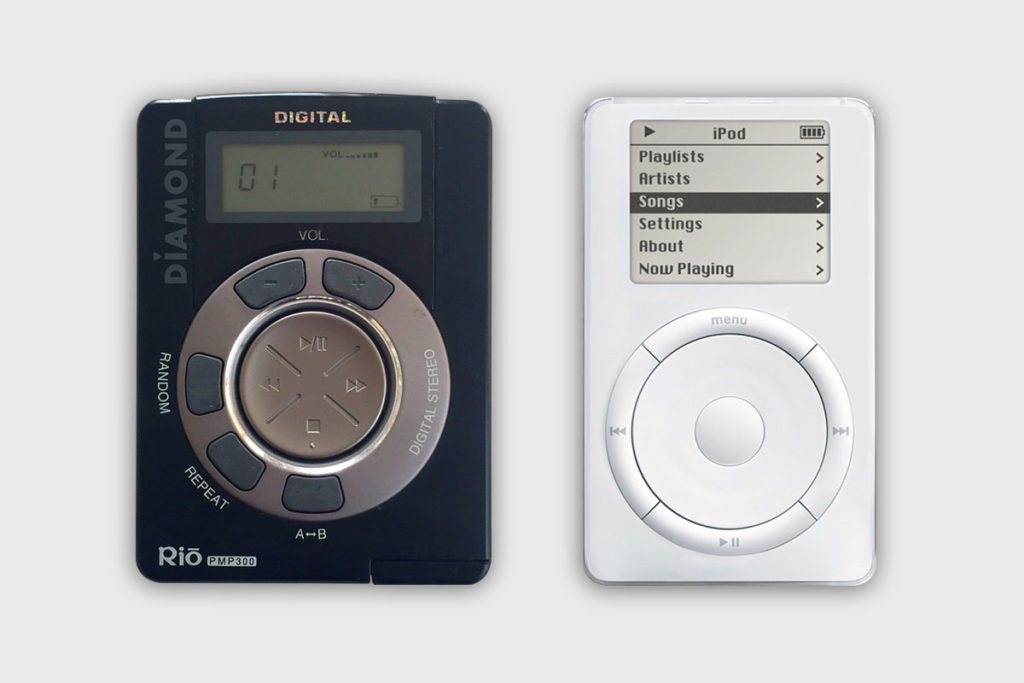
This is why usability is not the same as visual polish. A beautiful interface can still conceal the next step. A feature-rich product can still make the primary task harder. A service can satisfy its internal process while exhausting the person who needs help.
The working loop: understand, frame, make, test
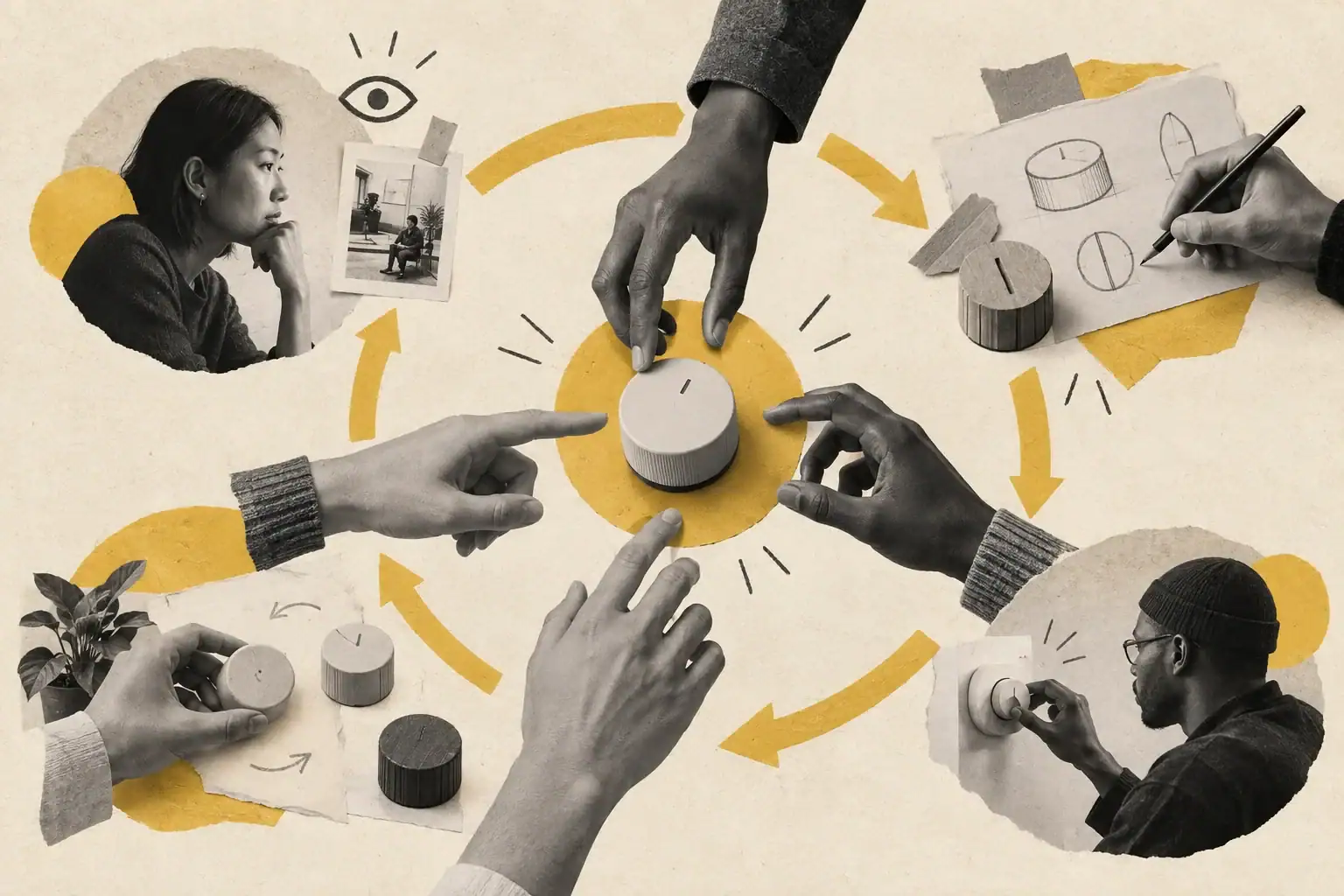
Human-centered design is often drawn as a neat sequence. In practice, it behaves more like a loop. New evidence can send the team back to the problem statement, the participant mix, or the prototype itself.
| Activity | The question | Useful evidence |
|---|---|---|
| Understand context | Who is trying to do what, where, and under which constraints? | Observation, interviews, support patterns, existing behavior |
| Frame the problem | Which outcome matters, and what is preventing it? | Research synthesis, task maps, clearly bounded needs |
| Make it testable | What is the smallest form that makes the idea real enough to evaluate? | Sketches, paper flows, role-play, physical or digital prototypes |
| Evaluate and refine | Where do people hesitate, improvise, fail, or succeed? | Observed tasks, usability findings, accessibility checks, outcome measures |
Research does not need to be enormous before it is useful. The GOV.UK Service Manual treats user research as a continuing practice across discovery, alpha, beta, and live service. It includes contextual observation, interviews, experience mapping, moderated usability testing, analysis, and participant privacy. Its user-research guidance is valuable because it connects methods to stages of real delivery.
Small studies can expose important problems, but a few participants cannot represent everyone. Keep the scope of the evidence visible. Record who participated, what tasks they attempted, which environments were missing, and where the team is still making an assumption.
Empathy needs evidence
Empathy matters, but empathy is not imagination. A designer cannot sit in a conference room, imagine another person’s life, and call that research. Empathy becomes useful when it changes how we listen, observe, ask questions, and respond to evidence that challenges our preferred solution.
Watch what people do as well as what they say. A participant may describe an interface as easy and then pause at every important step. Someone may create a workaround so familiar that they no longer mention it as a problem. The gap between stated confidence and observed behavior often contains the design opportunity.
Inclusion changes the design, not just the participant list
Human-centered design fails when “the user” becomes an imaginary average person. Ability, language, age, device, connection quality, environment, experience, and power all affect use. Include people who face the sharpest barriers early enough to change the work.
Accessibility standards provide essential requirements, but conformance checks do not reveal every usability problem. W3C’s Web Accessibility Initiative recommends combining standards evaluation with involvement from people with disabilities. It also cautions against generalizing from one person’s experience to everyone with a similar disability. W3C’s guidance on involving users is especially clear on that balance.
Inclusive design may produce more than one way to complete a task. A visible label can reinforce an icon. A keyboard path can complement pointer input. Captions can help someone who is Deaf or hard of hearing, someone learning a language, and someone watching in a noisy room. The point is not that one solution magically works for every person. The point is that the system does not make a single mode of use the price of participation.
Affordances and signifiers should reduce interpretation
A door with a flat plate suggests pushing. A raised handle suggests pulling. In an interface, the equivalent cues may be shape, position, label, state, motion, or feedback. These signifiers help people understand what action is available and what happened after they took it.
Do not confuse familiarity with universality. A symbol that feels obvious to an experienced team may be unclear to a first-time customer. Test the cue in context. If people need an explanation, redesign the cue before writing a longer instruction manual.
Human-centered design is a team capability
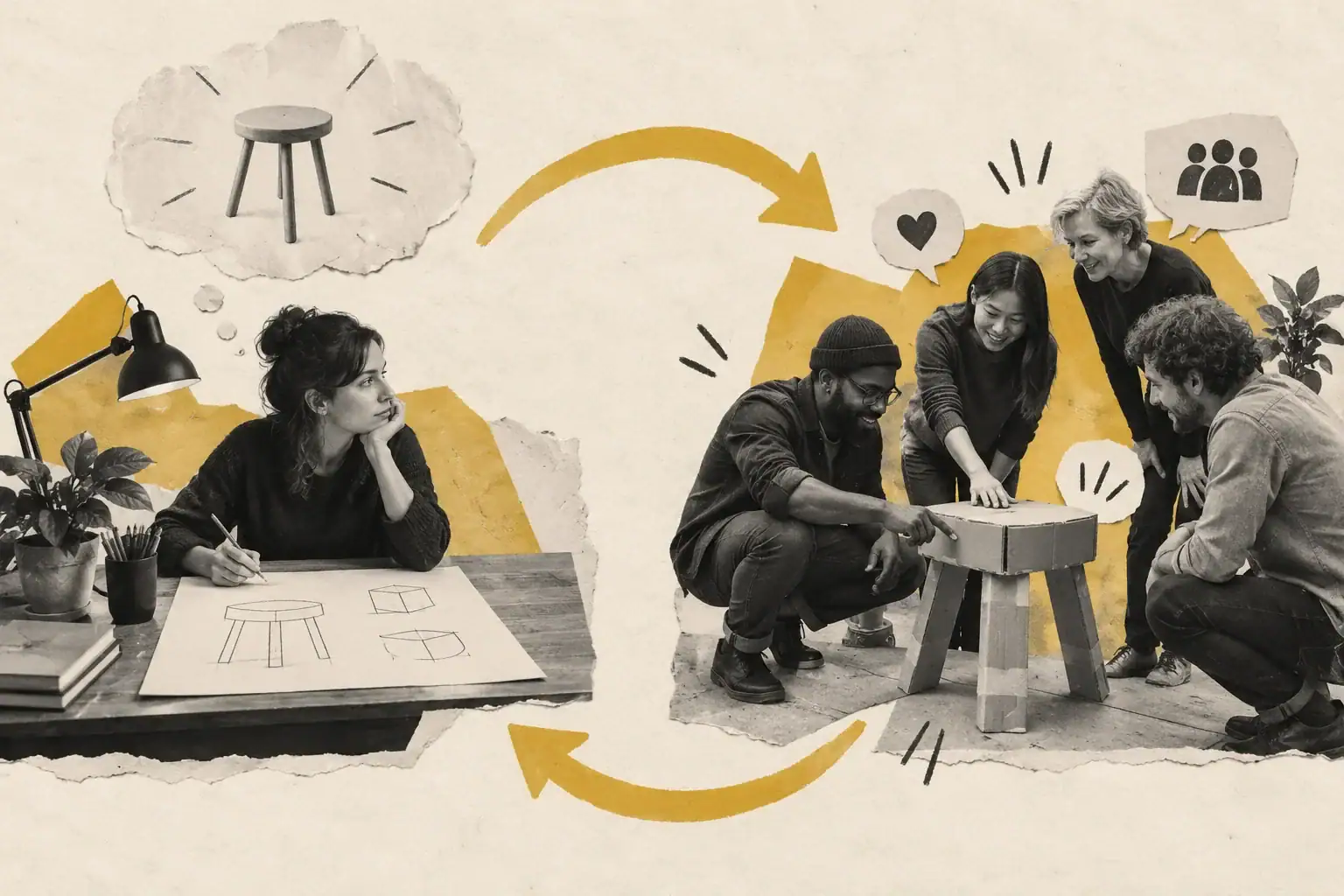
Researchers can reveal behavior. Designers can make alternatives tangible. Engineers can expose technical constraints and opportunities. Operations, service, sales, compliance, and support teams know where the experience breaks after launch. The people affected by the solution bring the evidence the organization cannot generate internally.
IDEO’s well-known shopping-cart “Deep Dive” is still worth watching as a historical demonstration of multidisciplinary exploration and prototyping. The process is energetic, but the more durable lesson is that ideas become useful only when a team makes them visible enough to question. Watch the original segment on YouTube.
A practical review before you call the design finished
- Can the team name the primary task in plain language?
- Has it observed the task in a realistic context?
- Are people with different abilities and levels of experience represented?
- Can a low-cost prototype reveal the biggest uncertainty before full production?
- Did testing change a decision, or did the team only collect approval?
- Are accessibility, privacy, safety, service, and operational constraints part of the design?
- Is there a way to learn after launch without turning people into surveillance targets?
The goal is not to remove every constraint or satisfy every preference. It is to make informed tradeoffs with a clear view of who benefits, who carries the friction, and what evidence supports the decision. Human-centered design matters because it turns people from an abstract audience into active participants in how a product, service, or system becomes useful.