When XFX began expanding in China, we ran into a branding problem that no amount of engineering could solve: some customers had difficulty saying the name.
The letters were familiar to us. We had built a brand around them, and inside the company they sounded as natural as our own names. But a name people struggle to pronounce is a name they hesitate to repeat, and a name they hesitate to repeat does not travel by word of mouth. A brand that cannot be recommended out loud is a bit like a restaurant without a sign. The food may be excellent, but the directions get complicated. We had a marketing problem before customers ever reached the question of whether they liked the product.
We agreed that a local name made sense. XFX’s Chinese name is Xùnjǐng, which the company history dates to 2004. What stayed with me was less the name itself than the lesson underneath it: a decision that works perfectly in one market can quietly become an obstacle in another. Ideally, you anticipate those possibilities when you choose a name. Often you discover them only after the business has started expanding, and then the question becomes how much of the brand you are willing to change in order to keep the rest of it moving.
That question, what can bend and what gives a brand its identity, is the real work of localization. It is also the question Nike is now trying to answer in China, at far greater scale and with far more at stake.
The numbers explain the urgency. In its fiscal 2027 first quarter, which ended August 31, Nike reported Greater China revenue of $1.18 billion, down 22 percent from a year earlier and 26 percent on a currency-neutral basis. In a September interview with China Daily, Greater China general manager Cathy Sparks described the company’s response: a local product creation team that has doubled in size, a vice president dedicated to that work, and Nike’s first apparel collection “created, designed and developed entirely in China,” scheduled to debut this holiday season. She described the goal as “elevating the voice of the Chinese athlete into our global product engine.”
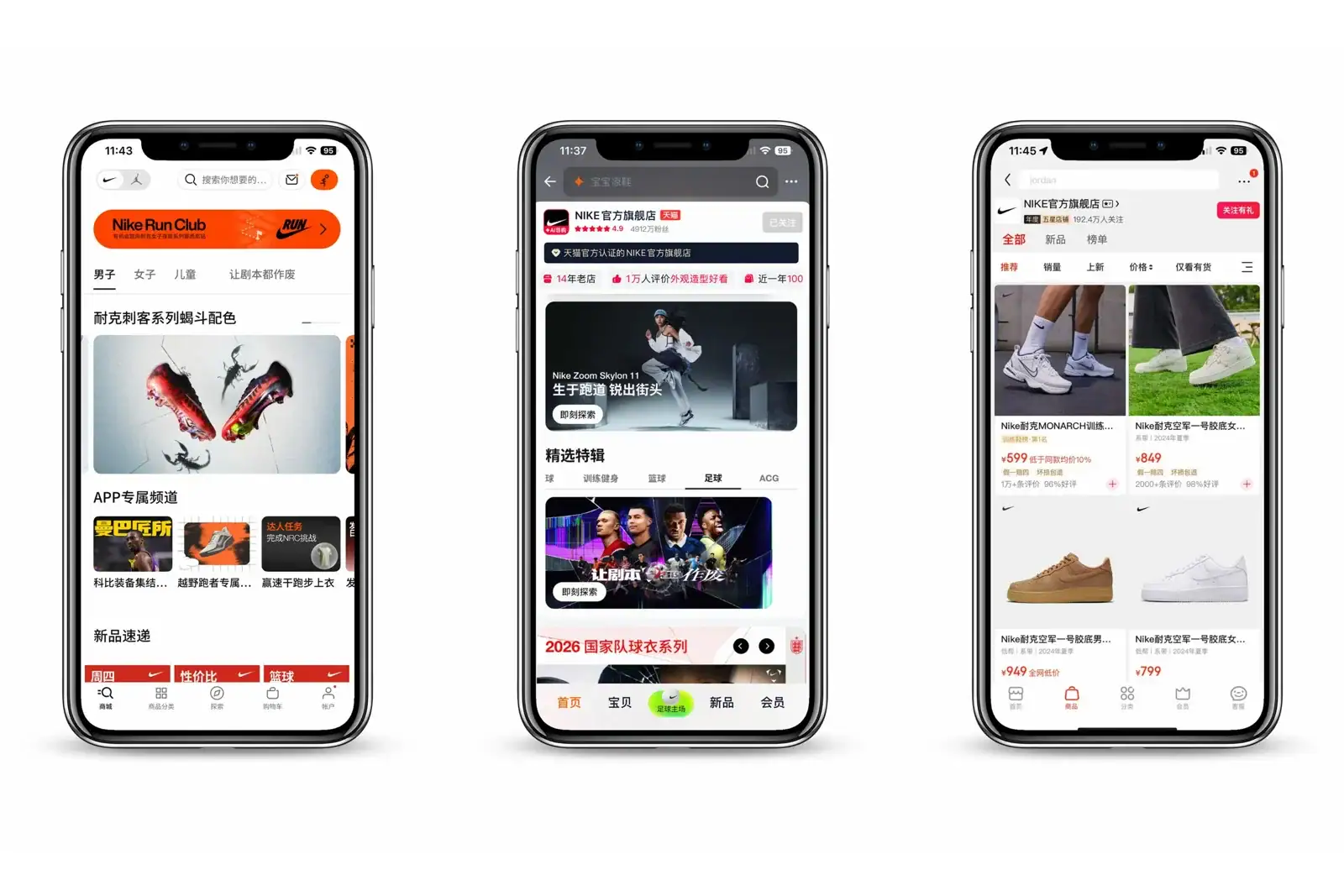
Nike is also tightening how it shows up online. Beginning in January 2027, sales of Nike products through partner-operated online storefronts, including those run by retail partner Topsports, will be discontinued, with some exceptions for licensee partners. That is not the same as leaving e-commerce. As Nike explained, Nike will keep selling through its own channels, including Nike.com.cn, the Nike app, and its own flagship stores on Tmall, JD.com and Douyin, and the company framed the change as a way to reduce fragmentation and build “a more consistent, premium and connected marketplace.”
“We have more work to do in NIKE Sportswear, Jordan Brand and Greater China”
Elliott Hill, Nike President and CEO, fiscal 2027 first-quarter results (excerpt)
These are plans, and plans are still being put into practice. Giving a local team more responsibility is a promising start, but authority is not the same thing as judgment. Whether the strategy works will depend on the quality of the decisions that team makes, and on how well headquarters and China learn to make them together.
My general belief is that a company should maintain strong control over its global brand. Customers should be able to recognize what a company stands for as it moves from one country to another. At the same time, buying preferences, shopping habits, cultural references and expectations vary considerably, and local management usually understands those differences better than someone studying the market from headquarters.
I have spent enough time around marketing teams in Asia to know that some of their approaches look distinctly different from the work I would produce for a Western audience. That does not make them ineffective. If an approach connects with customers and produces results, it deserves to be taken seriously, even when it looks unfamiliar to the people reviewing it from the other side of the world.
Local expertise has its own limits, however. People can become so accustomed to the way their market works that they stop considering other possibilities, and experience gradually hardens into an assumption that anything unfamiliar cannot work. I would be concerned about that attitude wherever it came from. A global team can be overconfident because a campaign succeeded at home. A local team can be equally confident that its customers will never respond to a different approach. Both are forms of certainty, and certainty gets expensive when a market is moving. Each side needs to leave room for testing.
If I were in the room with Nike’s teams, the first question I would want them to answer together is a basic one: why should a customer care about the authentic product?
During my trips to China, I have encountered fashion products where recognizable branding, imitation and ordinary functionality seemed to overlap in the shopper’s decision. Sometimes a misspelled brand name did not seem to matter to the person wearing it. That is an observation from my own experience, not a description of every Chinese consumer. But it made me wonder how much value a logo alone can carry when the shopper is weighing what it actually adds.
One answer is social meaning. In some communities, owning the authentic item communicates something important about the person who owns it, and a fake undermines the very impression they hope to make. The original is valuable because people recognize the difference and care about it. Another answer is the product itself. Can someone feel the difference in the material, notice it in the construction, experience it in how the shoe performs? Nike needs reasons to choose its products that stay persuasive when a cheaper alternative is sitting right next to them.
None of this makes counterfeits the explanation for Nike’s difficulties in China, and the country’s legitimate homegrown sportswear brands are competitors, not imitations. The point is about what a premium brand has to offer. Sparks made a related argument in her interview: “Premium doesn’t mean everything has to be expensive. Whatever the price is, the consumer needs to feel they’re getting the best value in the industry.” Asking people to value authenticity becomes much easier when authenticity delivers something they can identify.
The same scrutiny should apply to collaborations. A famous person who moves product in one country may mean very little in another. I would want to understand which Chinese athletes, musicians, designers and other cultural figures matter to the audience Nike hopes to reach. Recognition is only the first question. Does the person add credibility? Do people follow their choices? Is there a convincing reason for them to work with Nike beyond the size of the check?
I would also look beyond the obvious communities. Gaming, music, fashion and emerging sports could all be worth investigating. I would treat each as a possibility to research rather than assume that a trend elsewhere has reached China at the same scale or carries the same meaning there.
Nike’s identity gives it more room to explore than an athletes-only interpretation would suggest. What I associate with Nike is ambition: people pushing themselves, overcoming limitations and trying to become exceptional at what they do. An esports player can embody that. So can a musician developing a new sound or a designer challenging the conventions of a field. The connection simply needs to be credible enough that the audience can see it in the work. Attaching the swoosh to whoever happens to be popular this month would not satisfy me. Relevance has to be earned, not borrowed.
There are boundaries. A collaboration that conflicts with the brand’s established values can confuse people about what it stands for, and ethical concerns deserve serious consideration. Within those limits, I would encourage the local team to bring forward possibilities that headquarters might never have recognized on its own.
I have also learned that agreement sometimes comes from watching an idea develop rather than winning an argument about it. When our U.S. and UK teams at CyberPowerPC disagreed about creative direction, the UK team had strong views about the graphics and audience that suited its market. I had a different view of where our branding should go, particularly in reaching youth culture.
I did not force that direction on them. We implemented it in the United States and gave the work time to develop. Over roughly a year or two, the UK team became more comfortable with the approach. They could see where we were going and why that audience mattered, and eventually they adopted the direction we had been pursuing. That was a gradual change in conviction, not a mandate. The work itself gave us a more useful basis for discussion than another meeting about whose taste should prevail.
Put those two experiences side by side and they point in opposite directions, which is exactly why they are useful. At XFX, the company had to accept that something central to the brand, its name, needed to change for a local market. At CyberPowerPC, a local team came to adopt a direction it had initially resisted. Neither side was automatically right. In both cases, the brand got better because people were willing to let the market and the work settle what opinion could not.
That is what I hope Nike builds in China. The China team should have meaningful room to create, with shared standards that make its work recognizably Nike. The global team should contribute ideas and experience while staying willing to learn from what China develops, including ideas that might one day travel back to other markets. Localization is not a one-time translation of a global brand. It is an ongoing negotiation, and the healthiest version is one where both sides can propose an experiment, examine what happened and change their minds.
Nike has spent decades telling athletes that greatness comes from pushing past what they thought they could do. Its future in China may depend on whether the company can apply that same idea to itself.