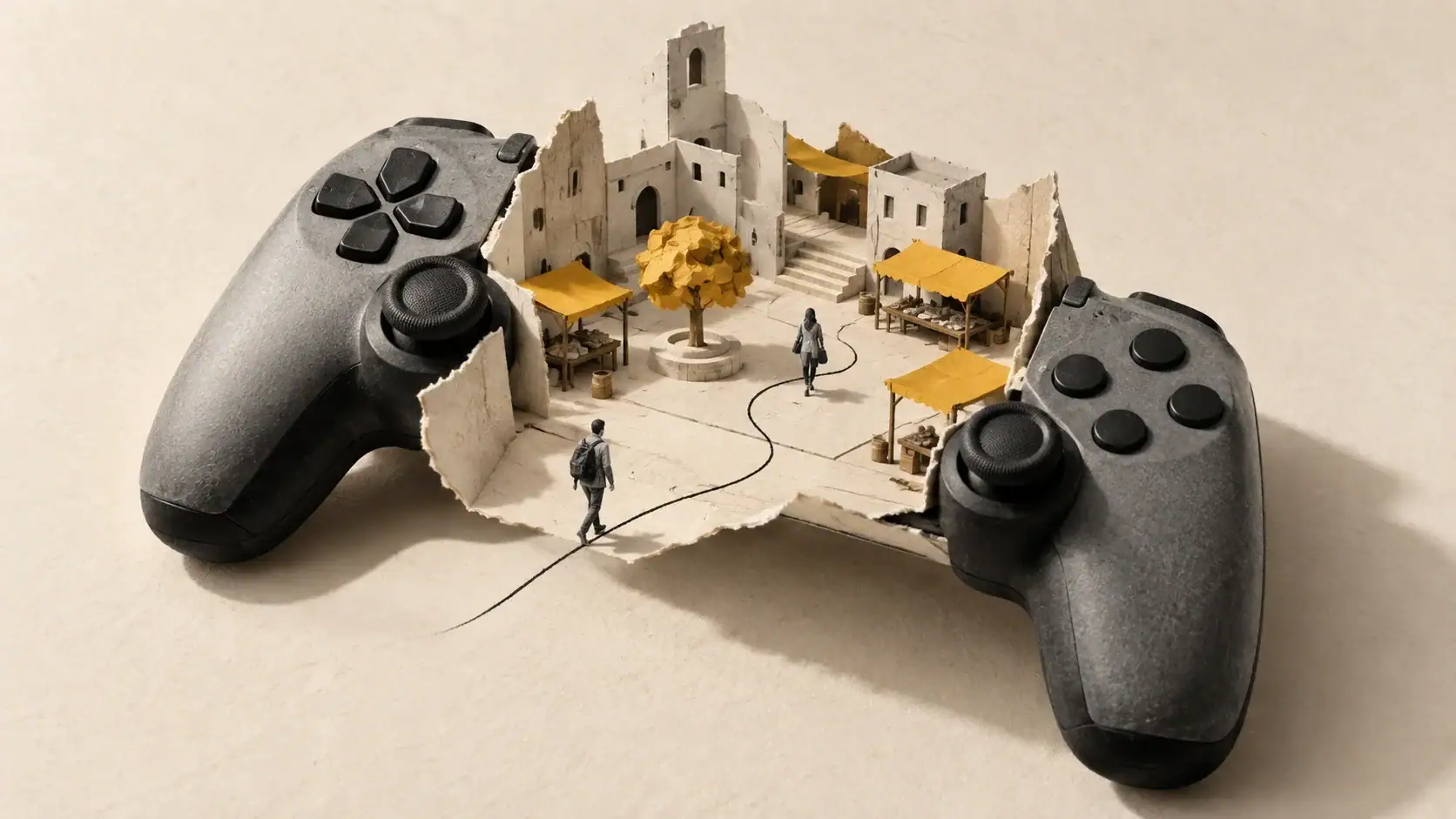
Not long ago I was in Chicago for an AMD retail summit. If you’ve never been to one, picture a room full of people who build, sell and market PCs for a living, sitting across from the people who design the chips, all trying to figure out where the next few years are headed. It’s one of my favorite parts of the job, because it’s where the real conversations happen.
At one point I said something that got more nods around the room than I expected. I told the AMD team that I thought they, and frankly Nvidia too, were treating AI and gaming as two separate stories. Look at where the attention goes: AI PCs, local AI, AI servers, business deployments. Gaming’s AI story is much narrower, usually a slide about making the picture look better, and then everyone moves on.
My argument was simple. AI and gaming aren’t separate stories. They’re the same story, and gaming is going to write a big part of the next chapter. I’ve made the same case to Nvidia since. A more convincing reflection is impressive. A world that remembers what you did, changes because of it, and lets you try something its creator never imagined is a different kind of promise.
I also have a less professional reason for caring. I have been waiting for this since I was a kid.
Gaming has done this before
This isn’t a hunch so much as a pattern. Gaming has a long habit of dragging new technology into the mainstream before anyone else knows what to do with it. The graphics chip itself is the obvious example: the hardware built to make games look better turned out to be the engine of the AI boom. Gaming helped turn live streaming into a major entertainment business. Justin.tv launched Twitch in 2011, and three years later Amazon agreed to acquire it for approximately $970 million. Games have even served as AI’s training ground; DeepMind used StarCraft II to build AlphaStar and study decision-making under pressure.
I like to joke that two things move major technologies forward: gaming and porn. I didn’t say that one out loud in the AMD meeting, for obvious reasons, but anyone who remembers the early internet knows I’m only half kidding. Both run on people wanting an experience badly enough to put up with clunky, expensive, early technology to get it. That appetite is what turns an invention into an industry.
We’re about to run out of reality to render
Right now, most of the AI conversation in gaming is about graphics. Upscaling rebuilds a sharp image from a smaller one, frame generation fills in extra frames so motion looks smoother, and Nvidia’s DLSS 5 goes a step further, using what its model has learned about real-world appearance to enhance the rendered image. Different jobs: upscaling and frame generation help with performance or smoothness, while neural rendering pushes visual fidelity and brings its own processing cost. You’ll hear people call it fake frames or AI slop. I understand the skepticism, but when it’s done well, play a game with it switched on and your eyes will tell you the truth. It looks incredible, and it gets dramatically better every year.
NBA 2K27 was the official DLSS 5 debut, and one hands-on review called it “a truly generational visual leap” that brings real-time graphics close to pre-rendered CGI. So here’s my prediction, and I’ll own it as a prediction: within a year or two, convincing photorealism will be common enough in leading games that the next jump in visual fidelity won’t feel revolutionary. Not every game on every machine, and a beautiful face still doesn’t guarantee believable movement or physics underneath it. But the image will be real enough that you stop judging it.
Here’s what nobody on those marketing slides wants to say: once you hit reality, reality becomes the baseline. The next frontier is the surreal, worlds that look real but behave in ways reality never could. Games have always offered fantasy. I want those fantasies to gain more of reality’s depth. Which means the graphics story, the one getting the most attention today, is about to become an old story.
Lunch with Nvidia, and a wave nobody controls
In a separate conversation over lunch with Nvidia, and the topic came up again. I made the same argument. Then I showed them something they hadn’t seen yet: modders had gotten DLSS 5 running on AMD Radeon cards, Nvidia’s direct competitor. The project is an independent rebuild of the software that still needs the user’s own copy of Nvidia’s files, and its developer is upfront that performance and compatibility are unfinished. The developer is still improving it, and the project remains an experiment rather than a polished substitute for official support.
They didn’t believe me until they saw it. Then one of the executives asked, “Is this even legal?” My answer reflected how hard it has become to keep up. I wasn’t offering a legal judgment about that project. I was pointing to how quickly experiments can outrun a company’s plans, while the questions about rights and permission still need answers.
What struck me was the contrast. In the launch discussions I was part of, the team was constrained to talking officially about DLSS 5 through NBA 2K27. Outside the building, enthusiasts were already asking where else it could go, and trying it on their own. They weren’t waiting for permission.
That’s the world we live in now. These companies created a wave, and it’s growing at a pace no one can steer. You don’t get to decide where it goes or how big it gets. You only get to decide whether you stay on the board or get tossed off. And if enthusiasts can start porting your signature feature to a competitor’s hardware within weeks, owning the graphics can’t be your whole gaming story.
The Twitch moment for games
So what’s the next story? I think it looks a lot like what live streaming did to television.
For decades, a handful of networks commanded the attention of billions of people. Then streaming arrived, and that attention shattered into millions of channels, each with an audience of thousands, sometimes millions, who loved them because they felt personal. Traditional networks suddenly had competition from people who had never needed a television studio.
AI is about to do the same thing to games, and the first sparks are already flying. My social feeds have been full of clips of people mashing familiar games together. Some are presented as AI-assisted experiments, but a viral clip doesn’t establish how a project was built or whether it survives extended play. Plenty of people call it slop, and the copyright questions are real. What excites me is the appetite for unusual combinations and the chance for more people to try them. Google has also put Project Genie, which generates playable worlds from a prompt and lets people remix them, into the hands of paying subscribers. At its launch, the prototype limited generations to 60 seconds. It is an early experiment, but early experiments are how these shifts begin.
There’s already proof that people will spend real time and money on games made by creators rather than studios. In 2024, creator-made games accounted for 36.5 percent of Fortnite playtime, and Epic paid those creators $352 million. That isn’t an AI effect, but it shows the audience and the business model are already here. Now AI is lowering the barrier further; Roblox’s 4D generation tools can create objects that actually work, like a car whose wheels turn.
When anyone can make a game, you won’t get a few dozen blockbusters a year. You’ll get thousands, then millions, each built for an audience that loves it because it feels made for them. An odd little game doesn’t need to replace a franchise to win someone’s Friday night. Enough of them will pull real attention, and real money, away from publishers like EA, Activision Blizzard and Ubisoft, whose titles take years and hundreds of people to produce. The big studios will keep real advantages in craft, talent and famous worlds, and some will win by running the platforms these creators build on. But the range of ideas worth trying is about to explode.
That’s why I told AMD to go find these people. Talk to them. Fund them. Give them tools, hardware and technical help. Bring them into the room. The mechanics they invent in their bedrooms today will become the staples everyone copies tomorrow.
Worlds that remember you
When I imagine where this goes, graphics are almost beside the point. What gets me excited is depth.
Picture an open world where every character remembers you. Your conversations aren’t limited to a fixed script; they develop from what you say and do. Kill someone, and they don’t respawn. Maybe their kid grows up wanting revenge.
Or keep it small. Imagine a game that’s nothing more than a farmers market. Every vendor has inventory, bills, ambitions and a memory, guided by their own survival. One needs to sell before his produce spoils. Another can afford to wait. I can haggle one seller down, then play him against his neighbor. I can start a rumor and watch it travel farther than I meant it to. Now add a second human player doing the same thing, with promises and grudges of their own, and the complexity doesn’t just double. It explodes. The whole market could fit in one small square and still hold an extraordinary amount of play.
For that to work, memory has to matter. If a vendor sells me the last five apples, those apples are gone, even when the next player shows up. Otherwise all that clever conversation adds up to an extremely articulate shop menu.
This isn’t pure fantasy. In 2023, researchers at Stanford and Google built a small simulated town of 25 AI characters who remembered, planned and talked to each other. Seeded with one character’s wish to throw a Valentine’s Day party, the townspeople spread the invitations, asked each other out and showed up together, with no one scripting it. That was a research demo. Games are where that idea grows up.
To be fair to the companies I’ve been needling, they’re working on pieces of this. Nvidia’s ACE offers tools for characters that talk and act, and AMD’s Schola helps developers train AI agents inside Unreal Engine. Google DeepMind’s August 2025 Genie 3 demonstration generated worlds that stayed consistent for minutes, while identifying longer play and complex interactions among multiple agents as limitations. My complaint isn’t that nobody is working on it. It’s that this work is a whisper in the gaming story when it should be the headline.
That’s the next level of gaming: a world as complex and alive as this one, an escape into another reality that’s every bit as deep.
Everyone says gaming is dead. They have it backwards.
Right now the whole tech industry is obsessed with AI, and you can see it everywhere. AI demand is soaking up so much of the world’s memory supply that prices keep climbing for everyone else, and Samsung’s latest results describe putting server products first while supply stays tight. The scale of the shift is visible in Nvidia’s second-quarter fiscal 2027 results: data centers brought in $89 billion of its $96.2 billion in revenue. The real money is going to AI servers and AI supercomputers. No wonder people are saying gaming is dead.
I understand why it looks that way. I’ve argued before that gaming isn’t dead, and the last few months have only made me more sure. The people writing gaming’s obituary are forgetting where AI is actually going.
Think about what most people use a computer for. Browsing. Email. Word documents, spreadsheets, presentations. Even demanding work like graphic design, 3D modeling and video production. AI is getting so good that more and more of it will be handed off. You won’t build the presentation; you’ll prompt it. You won’t stare at a spreadsheet; you’ll ask what it means and what you should do about it. A spreadsheet was only ever a container for data. What matters is what you can learn from it, and that’s exactly the gap AI bridges. Your judgment still matters enormously. Owning a powerful desktop matters a lot less.
When that happens, the computer stops being the thing that does the work. It becomes a terminal, a window into the AI doing the work for you. Local AI will keep getting better and will have real advantages in privacy, speed and working offline. My expectation is that the largest frontier models will remain centered in the cloud, with capabilities that most personal machines cannot match. At that point, the phone in your pocket is enough. Plug it into a display and you have the equivalent of a powerful computer, with what feels like an entire organization behind you.
So what survives? Gaming. Because gaming is something people want to do themselves. Having AI build my presentation saves me work. Having AI play my game for me would take away the very thing I came for. Even when it moves into VR, you still need a machine that responds to everything you do. And the worlds I described above, full of characters with memories and lives of their own, will demand more processing and memory, not less. Even as graphics level off, the complexity underneath them keeps growing.
Cloud gaming shows some of that work can happen remotely, but it lives and dies by your connection; Nvidia’s own GeForce NOW requirements spell out the latency it needs. My bet is that responsiveness and control will keep dedicated gaming hardware in people’s homes for a long time.
Here’s how I see the hardware market shaking out: AI terminals for everyday life, servers doing the heavy lifting in the cloud, and gaming machines for the experiences people want to live through. The lines will blur, and specialized workstations will still have their place. But the ordinary desktop, the box we bought to run spreadsheets, is the one that will struggle to justify itself.
So don’t count gaming hardware out. It may look like it’s slowing down while the money chases data centers, but AI is going to create the next generation of gaming hardware, and gaming machines are going to outlast a lot of what we call computers today.
Why I want this to happen faster
I’ll be upfront about where I stand. A lot of people hate on AI right now. I’m not one of them, at least not when it comes to games.
I’ve been a gamer since I was a little kid. Almost every career move I’ve made since has been about staying close to games and helping make them better. I watch Sword Art Online and Shangri-La Frontier and think, when do I get my NerveGear? I grew up on the Star Trek holodeck, and that’s the life I want to experience someday.
Now that I’m nearing fifty, I feel mortality creeping in. I’ll admit I’m almost personally angry at how much this industry protects safe, proven revenue instead of betting on what’s next. I understand why it happens. But an industry built on imagination should be willing to put more behind the unfamiliar. I would be disappointed in life if everything I saw in science fiction stayed fiction.
Am I blind to the risks? No. We all know AI could become dangerous. People deserve control over their work and identity, and players deserve protection from systems built to exploit their attention or trust. Science fiction has given us decades of warnings to learn from. So yes, regulate it. Just don’t let regulation become an excuse to stand still.
That’s the message I’ve been bringing to AMD, Nvidia and anyone else who will listen. I think the graphics race is approaching the point where realism alone will no longer be enough. The real race is to build worlds worth escaping into, and it’s already being run by people who don’t work for you. Get in the conversation, back the creators, and ride the wave. The companies treating gaming as a footnote to AI are going to find out it was the headline all along.
As for me, I want to step into a world that remembers I was there. And I’d really like to get there while I still have time to explore it.