
Before a technology trade show a few days back, I gave two members of my team what seemed like a reasonable assignment. I wasn’t asking them to earn a computer science degree or memorize processor specifications. I just wanted them to be able to hold an intelligent conversation when talking to customers or other industry professionals. Know what a CPU does. Understand the difference between memory and storage. Grasp why an SSD behaves differently from a mechanical hard drive. Nothing exotic. The kind of literacy you’d expect from anyone representing a tech brand publicly.
More importantly, I handed them what I genuinely believe is the most powerful learning tool ever put in front of a human being and told them to use it. I told them to use ChatGPT.
When I came back from a business trip, their explanations still showed substantial gaps, despite the effort they had made.
My first instinct was to question the process. Maybe the assignment had not been clear enough. Maybe I had given them too little time. A colleague who had also explained the goals and tried to help suggested that we needed to teach the learning process itself. I sat beside one team member to see where understanding was breaking down. What I observed was more useful than assuming the tool or the person was the problem.
She would type a question. ChatGPT would answer. She would read it, nod, and announce she understood. I would ask her to explain it back to me. Important parts would be wrong. Not slightly off. Fundamentally wrong.
What caught my attention wasn’t the misunderstanding. Technical subjects are hard, and nobody gets it all on the first pass. What caught my attention was the speed at which confidence arrived. The moment information had been consumed, understanding was assumed. The gap between the two had collapsed entirely in her mind, even when it hadn’t collapsed at all in reality.
To be fair, I’ve done the same thing myself more times than I’d like to admit.
This pattern repeated itself throughout the afternoon. She would ask ChatGPT about CPU cache. It would give her a technically accurate explanation involving high-speed memory, latency, and frequently accessed data. She would read it and tell me she got it. When I asked her to explain the mechanism, she said it helped things load faster. That’s the kind of answer that reveals recognition without comprehension. She could identify the concept the way you can identify a face in a crowd without knowing anything about the person.
So I suggested something different.
“Ask ChatGPT for an analogy.”
A few seconds later, the whole conversation changed. ChatGPT described the CPU as chefs working in a busy kitchen. The cache was the countertop immediately in front of them, holding only the ingredients needed right now. RAM was the nearby pantry, stocked with far more but still reachable without leaving the kitchen. Long-term storage was the grocery store, containing everything else but requiring a real trip to retrieve.
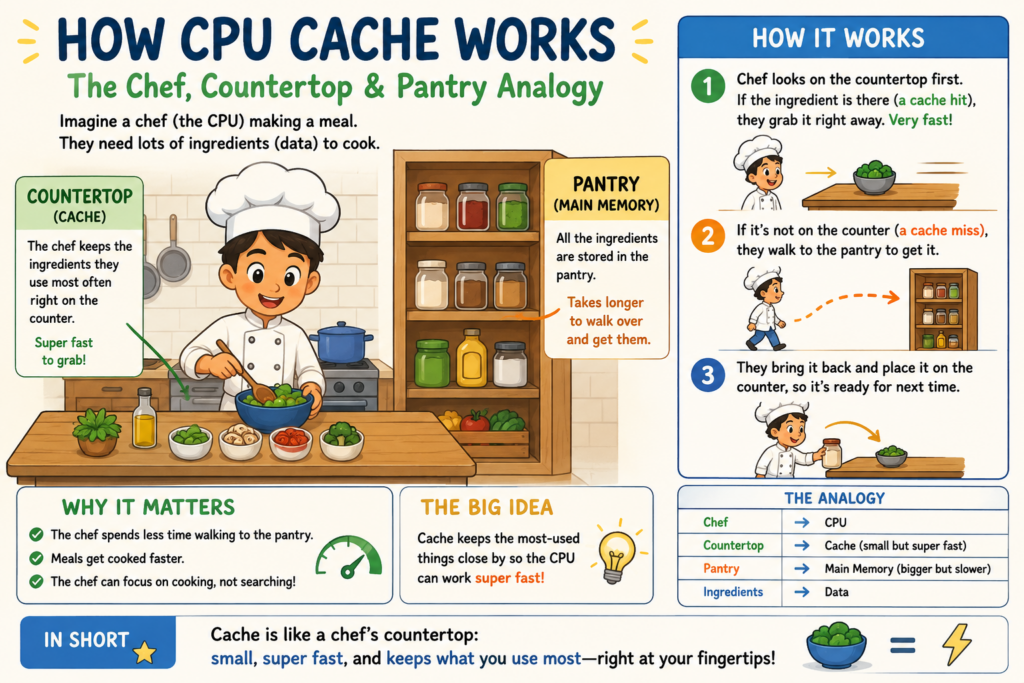
Suddenly she was building something in her mind instead of collecting vocabulary.
I told her to keep going. Ask for another analogy. Ask how it applies to video games. Ask what happens when the countertop gets too crowded. Ask it to explain the same thing as if she were twelve, and then as if she were an engineer. Ask it where she’s wrong.
As the conversation continued, I could see the shift happen in real time. She wasn’t trying to obtain answers anymore. She was trying to understand a system. And that distinction, small as it sounds, turns out to be everything.

For most of modern history, we’ve treated learning as an access problem. The assumption was that if people had enough information, they would become knowledgeable. That assumption made perfect sense in a world where finding the answer was genuinely difficult. Libraries were finite. Experts were hard to reach. Time was the enemy.
That world is gone.
A connected phone can put a vast range of explanations within reach. ChatGPT can reframe a concept, offer examples and respond to follow-up questions. Access still depends on connectivity, language, product limits and other circumstances. And availability does not guarantee accuracy. The opportunity is to make learning more interactive, not to assume the information problem has disappeared.
Yet somehow, having unlimited access to information has not automatically produced understanding. In many cases, it may be making the confusion worse by making it easier to mistake one for the other.
Rozenblit and Keil’s 2002 research describes a related pattern. The illusion of explanatory depth describes the consistent tendency of people to believe they understand something until they are asked to actually explain it. Studies have found that most people think they understand how a toilet flushes, how a zipper works, how a bicycle stays balanced. Then someone asks them to explain the mechanism, and confidence collapses almost immediately. The knowledge was always shallower than it felt.
What I watched that afternoon was this illusion in a small workplace example, amplified by a tool that provides answers so fluently and so confidently that the distinction between reading and understanding becomes almost invisible.
Here is what I think is actually happening with people and AI.
Decades of search engines trained an entire generation to treat information retrieval as the goal. You typed a query. You received an answer. The task was complete. The habit became deeply ingrained: input question, receive output, move on. Search rewarded keywords. It rewarded retrieval speed. It rewarded completion.
Conversational AI operates on an entirely different logic, but nobody explained that to most users. So they approach it the same way they approached Google. They type fragments. They collect the first answer. They close the tab. And then they wonder why they still don’t really understand the thing.
The most effective people I’ve watched use AI don’t behave like that. They behave less like someone running a search and more like someone in a genuine tutoring session. They question the first answer. They ask for a different framing. They request examples from domains they already understand. They ask the AI to push back on their assumptions. They say “I think I understand but I’m probably wrong about this part, tell me where.” The conversation goes ten or fifteen exchanges deep before they feel like they’ve actually grasped something.
There is something else that separates these users, and it might be the most important thing. They do not assume the AI is right.
This sounds obvious until you watch how most people actually behave. The default posture toward a confident, fluent answer is acceptance. The answer arrived. It sounded reasonable. Case closed. But the person who is genuinely trying to understand something does the opposite. They use their confusion as a probe. They ask the AI to confirm what it just said, to restate it a different way, to defend the claim. And something interesting happens when you do that. You don’t just deepen your own understanding. You frequently discover that the original answer was vague, or generalized, or subtly incomplete in ways that only become visible when you push on them.
This is one of the stranger properties of conversational AI that most people never discover. It does not always give you its best answer first. A first response can be incomplete or wrong. A more useful answer may emerge through follow-up questions, after you’ve forced it to be more precise about something it glossed over, or corrected an assumption it made about what you were actually asking. The interrogation can improve the response, but it can also produce a more elaborate mistake. OpenAI advises checking important information against reliable sources. Asking the same model to confirm itself is not independent verification.
The person who treats AI as an authority collects whatever it offers. The person who treats it as a collaborator gets something considerably more useful, partly because they extract more from the tool, and partly because they are building their own understanding in the process of doing so.
What separates these users from the others isn’t technical skill. It’s intellectual humility. They are comfortable exposing what they don’t know. They are comfortable sitting with confusion long enough to work through it. They don’t mistake the feeling of having read something for the experience of having understood it.
The AI conversation has been dominated by concerns about what the technology will replace. I think that’s the wrong question. The more revealing question is what AI exposes about the people using it.
Used carelessly, it produces a very sophisticated version of the same illusion we’ve always had. People walk away feeling informed when they are merely exposed. Used seriously, it is arguably the best thinking partner most people have ever had access to, infinitely patient, available at any hour, capable of explaining the same concept thirty different ways until something finally clicks.
The technology, the quality of the explanation and the support around the learner all matter. So does the habit of testing understanding instead of stopping when an answer feels familiar.
That gap has always existed. AI didn’t create it.
But it’s making it impossible to ignore.