
Post-purchase engagement begins the moment the payment clears. The customer is no longer deciding whether to trust the promise. They are watching to see whether the company can keep it.
That makes this part of the journey much bigger than shipment tracking. It includes delivery expectations, exceptions, returns, product adoption, loyalty, referrals, feedback, and the handoffs between customer service and operations. The software market reflects that complexity. Tools described as post-purchase platforms often solve very different jobs.
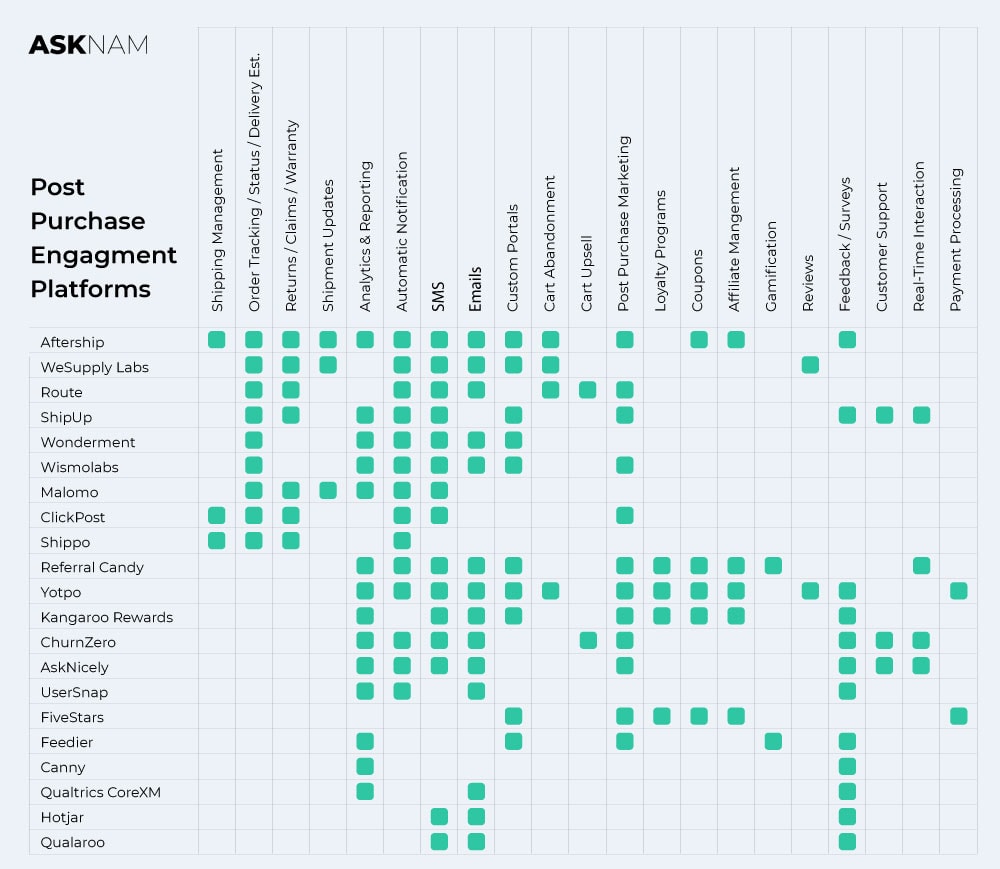
This guide originally ranked 21 products in one long list. After reviewing their current positioning, I do not think a universal ranking is useful. A shipping platform, loyalty system, customer-success platform, and research tool cannot be compared as though they are interchangeable. The better approach is to define the customer problem, choose the correct category, and then evaluate a short list against your own journey.
Start With the Broken Moment
“Improve post-purchase engagement” is too broad to become a software requirement. Start with a moment you can observe. Customers cannot find an accurate delivery date. Returns require an email exchange. New users do not reach the first useful outcome. Loyal customers receive the same treatment as first-time buyers. Product teams collect feedback but cannot connect it to decisions.
Write the problem as a customer outcome, not a feature request. “Reduce Where Is My Order contacts” can push a team toward deflection at any cost. “Give customers a reliable answer and next step without making them contact support” creates a better standard. It leaves room for proactive communication, self-service, exception handling, and a clean human handoff.

Five Different Jobs Hide Inside “Post-Purchase”
The 21 products below were reviewed against their official product pages on September 10, 2026. The table preserves the useful breadth of the original article, but it does not claim that every platform was personally tested. Product scope changes quickly, so treat these descriptions as a starting map and confirm integrations, regions, limits, and contract terms directly with each vendor.
1. Delivery visibility, returns, and protection
| Platform | Primary job | Good fit when |
|---|---|---|
| AfterShip | Tracking, returns, shipping, delivery estimates, warranties, and order edits | You want a broad post-purchase suite across several operational moments |
| WeSupply | Order tracking, returns, exchanges, and post-purchase analytics | You want tracking and returns tied to customer and operational reporting |
| Route | Package protection, tracking, and returns | Delivery protection and claims are central to the experience |
| Shipup by ZigZag | Tracking, returns, delivery incidents, and carrier claims | You need delivery communication and reverse logistics in one workflow |
| Loop Tracking (formerly Wonderment) | Branded tracking and delivery communication connected to returns | You already use or are considering Loop for returns |
| WISMOlabs | Tracking, notifications, self-service, exception context, and analytics | You need communication to respond to the full delivery situation |
| Malomo | Branded tracking pages and transactional communication | Shopify-based lifecycle marketing is a major priority |
| ClickPost | Multi-carrier shipping, tracking, exceptions, returns, and delivery decisions | You have complex carrier operations or high shipping volume |
| Shippo | Shipping labels, carrier rates, tracking, returns, and shipping APIs | Shipping execution is the core need and post-purchase features support it |
This category is where teams most often buy too much or too little. A branded tracking page may solve a communication problem without replacing shipping software. A returns portal may improve exchange flows but do nothing about carrier exceptions. A broad suite may reduce integration work, while a specialist may offer deeper control over one painful moment.
2. Loyalty and referrals
| Platform | Primary job | Good fit when |
|---|---|---|
| ReferralCandy | Customer referral programs | Word of mouth is the specific behavior you want to encourage and measure |
| Yotpo | Loyalty, reviews, and ecommerce retention | You want loyalty and customer advocacy connected within an ecommerce stack |
| Kangaroo Rewards | Points, tiers, offers, messaging, and omnichannel loyalty | You need loyalty to work across ecommerce and physical locations |
| SumUp Connect (formerly FiveStars) | Local-business loyalty, rewards, customer records, and messaging | Your post-purchase relationship is tied closely to point-of-sale visits |
Do not start this category by choosing a points system. Decide which behavior deserves recognition and why it matters to the customer. A referral, review, repeat order, membership milestone, and store visit are not the same signal. The reward should feel consistent with the brand and should not train customers to wait for a discount.
3. Customer success and adoption
| Platform | Primary job | Good fit when |
|---|---|---|
| ChurnZero | Customer onboarding, adoption, health, retention, and account growth | You manage ongoing B2B or subscription relationships after the sale |
ChurnZero is the clearest outlier in the original list. Its post-sale problem is not primarily a parcel. It is whether an account reaches value, adopts the product, receives the right intervention, and renews. That makes sense for recurring relationships, but it should not be ranked against a shipping-label platform.
4. Voice of customer and product feedback
| Platform | Primary job | Good fit when |
|---|---|---|
| AskNicely | Real-time customer sentiment and frontline action | Multi-location service teams need feedback connected to daily coaching |
| Usersnap | Product feedback, research, visual bug reports, and evidence management | Product teams need traceable feedback connected to prioritization |
| Feedier | Customer intelligence across surveys, reviews, tickets, CRM, and other signals | You need to combine dispersed feedback with business context |
| Canny | Feature requests, feedback capture, prioritization, roadmaps, and updates | You need a visible closed loop between requests and product decisions |
| Qualtrics | Enterprise experience management and research | You need governed research and action across complex customer or employee programs |
| Contentsquare (the current home of Hotjar) | Heatmaps, session replay, funnels, surveys, and digital-experience analysis | You need behavioral evidence about where digital journeys break |
| Qualaroo | Contextual website and in-app surveys, targeting, and feedback | You need to ask a focused question at a specific point in the experience |
Feedback is not engagement by itself. A survey can become another demand on the customer if nobody owns the response. Before choosing a tool, define who will review the signal, how it will connect to an account or journey, what action it can trigger, and how the customer will learn that their input mattered.
Build a Shortlist Around the Journey
Once the category is clear, compare platforms against a real journey rather than a generic feature list. Use one normal order or account, one difficult exception, and one edge case. Map every event from the system of record to the customer message, internal action, and final resolution.
- Event coverage: Which order, shipment, return, account, or feedback events can the platform actually receive?
- System ownership: Which platform remains the source of truth when records disagree?
- Integration depth: Is the connection a real two-way workflow, a data export, or a logo on an integrations page?
- Customer handoff: What happens when self-service cannot solve the problem?
- International fit: Are the necessary carriers, languages, currencies, regions, and privacy controls supported?
- Operating effort: Who builds journeys, updates rules, reviews exceptions, and maintains content after launch?
- Measurement: Can the team connect platform activity to resolution, repeat contact, return outcomes, adoption, retention, or another real business result?
Pilot the Failure, Not Just the Demo
A sales demonstration usually follows the clean path. Your pilot should include the moments that create customer anxiety: split shipments, missed scans, an address correction, a damaged item, an exchange with inventory constraints, a failed referral credit, conflicting account data, an angry survey response, and a request that needs a person.
| Pilot question | Evidence to capture | Failure signal |
|---|---|---|
| Did the customer understand what happened? | Message clarity and next-step comprehension | Repeat contacts or contradictory updates |
| Did the workflow reach the right owner? | Routing history and response time | Manual forwarding or abandoned cases |
| Did the platform preserve the correct record? | Order, account, consent, and event audit trail | Duplicate, missing, or overwritten data |
| Did the experience improve? | Resolution, effort, adoption, exchange, retention, or feedback closure | A better dashboard with no better customer outcome |
The Best Platform Is the One That Closes a Defined Gap
No platform becomes valuable because it appears first in a roundup. It becomes valuable when it removes a specific point of friction without fragmenting the rest of the experience.
Begin with the broken moment. Decide which category owns it. Shortlist tools against the systems and constraints you already have. Then test a real customer journey, including failure, before committing to a broad rollout. That sequence will tell you more than a rating, a feature count, or any universal “best” label.
For the operating principles behind this selection process, see my guide to improving post-purchase engagement.
Editorial Process:
Our reviews are done by myself and come from my own experiences. I may not have used some products recently, so my reviews may reference details such as specifications and features that may have changed since I last used them. Let me know if you find any discrepancies.
Some of the links in this article may be affiliate links, which can compensate us at no cost if you decide to purchase a paid plan. These are products we’ve personally used and stand behind. This site is not intended to provide financial advice. You can read our affiliate disclosure in our privacy policy and editorial disclosure.