
The most useful way to compare AI voices is still to listen. Feature lists change, pricing moves, and every platform describes its latest model as natural. A difficult word, an awkward pause, or a sentence that needs emotional restraint tells you more.
I originally tested these ten text-to-speech platforms in December 2023. I had already been using synthetic voice tools to create podcast versions of articles, audio for social posts, and voiceovers for commercial video. For this comparison, I used the same short passage across the platforms and deliberately included words such as Nike and brioche that could expose differences in pronunciation, pacing, and control.
The original audio and interface screenshots remain below. They are evidence of what I heard and used at that time, not a claim that every product sounds or works exactly the same today. The market has moved too quickly for a 2023 test to masquerade as a live 2026 ranking. What has lasted is the testing method and the practical distinctions between a voice generator, an editing studio, and speech infrastructure.
The original reference recording
Start with my original voice. It provides a reference for cadence, emphasis, and pronunciation before any synthetic version enters the comparison.
What still matters when choosing an AI voice tool
“Most realistic” is not a complete buying criterion. A beautiful demo voice may be frustrating in production if names are hard to correct, long files render slowly, or the editor makes every revision expensive. A platform with less expressive output may be the better system when it offers predictable API behavior, clear licensing, and reliable scale.
| Need | What to test | Why it matters |
|---|---|---|
| Editorial workflow | Script editing, retakes, timeline control, and export | The voice is only one step in production |
| Natural delivery | Pacing, emphasis, emotional restraint, and long-form consistency | Short demos can hide problems that become obvious over several minutes |
| Pronunciation | Names, brands, acronyms, numbers, and regional vocabulary | Correction tools often matter more than the size of the voice library |
| Scale and integration | API, latency, usage reporting, formats, and failure handling | Business systems need reliability, not only a good sample |
| Rights and governance | Consent, commercial terms, deletion controls, and disclosure | A technically possible voice may still be inappropriate to use |
| Localization | Native review in each language and regional accent | A language count does not prove culturally accurate delivery |
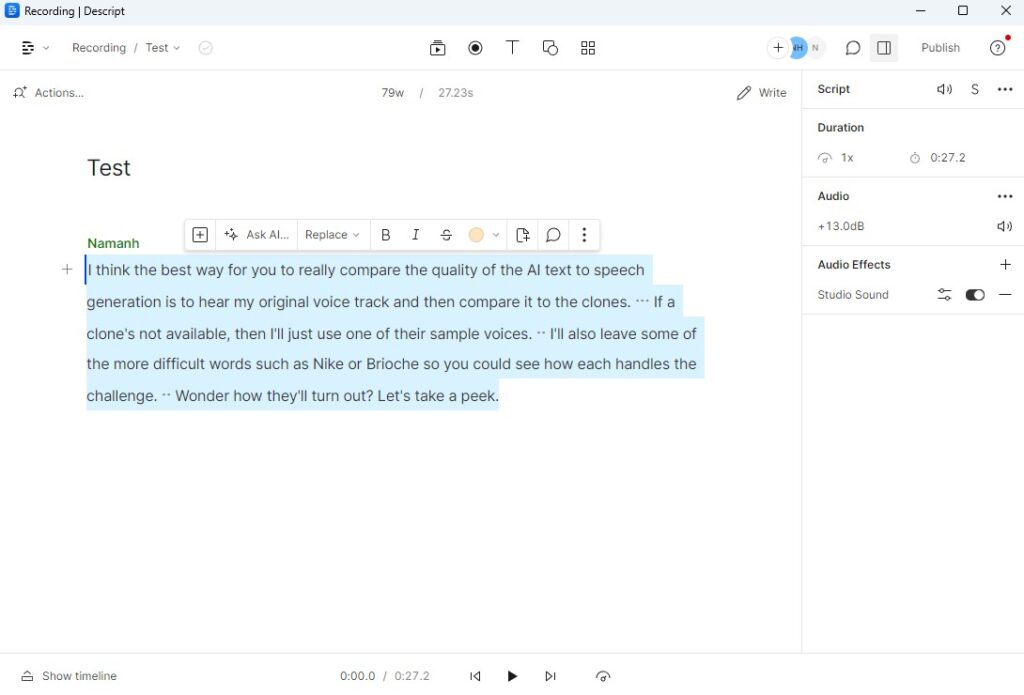
Descript: the editing workflow was the real advantage

Descript stood apart because I was not simply generating a voice file. I could edit spoken media through text, move between transcription and voiceover, and keep the work inside a broader audio and video workflow. Its synthetic voice was not always the most expressive in my test, but the surrounding editor reduced production friction.
That distinction still matters. Descript’s current product describes AI speech and a Regenerate feature for repairing or recreating speech inside edits. Evaluate it as an editor with synthetic speech, not as a voice library competing on sound alone. My 2023 experience also included occasional lag and processing problems on heavier projects, so test it with the length and complexity of your real work.
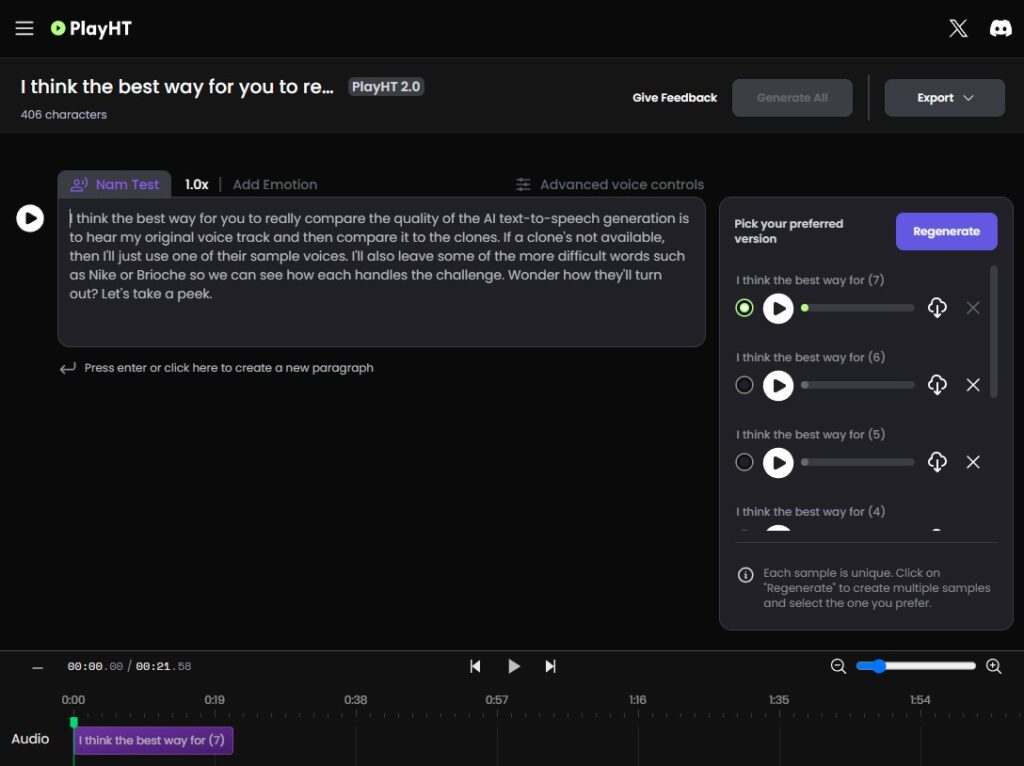
PlayHT: expressive speech with pronunciation tradeoffs

PlayHT produced one of the more natural samples in my original test. I liked its inflection controls and the speed with which it could create a recognizable clone from a short recording. That convenience also exposed a limitation: when a specific word was consistently wrong, I sometimes had to rewrite it phonetically instead of teaching the system a durable pronunciation.
The product and branding around PlayHT have evolved since this test, so treat the sample as a historical result and verify the current service, model, rights, and controls before choosing it. The lasting question is whether expressive output remains controllable when the script contains names, regional language, and repeatable brand terminology.
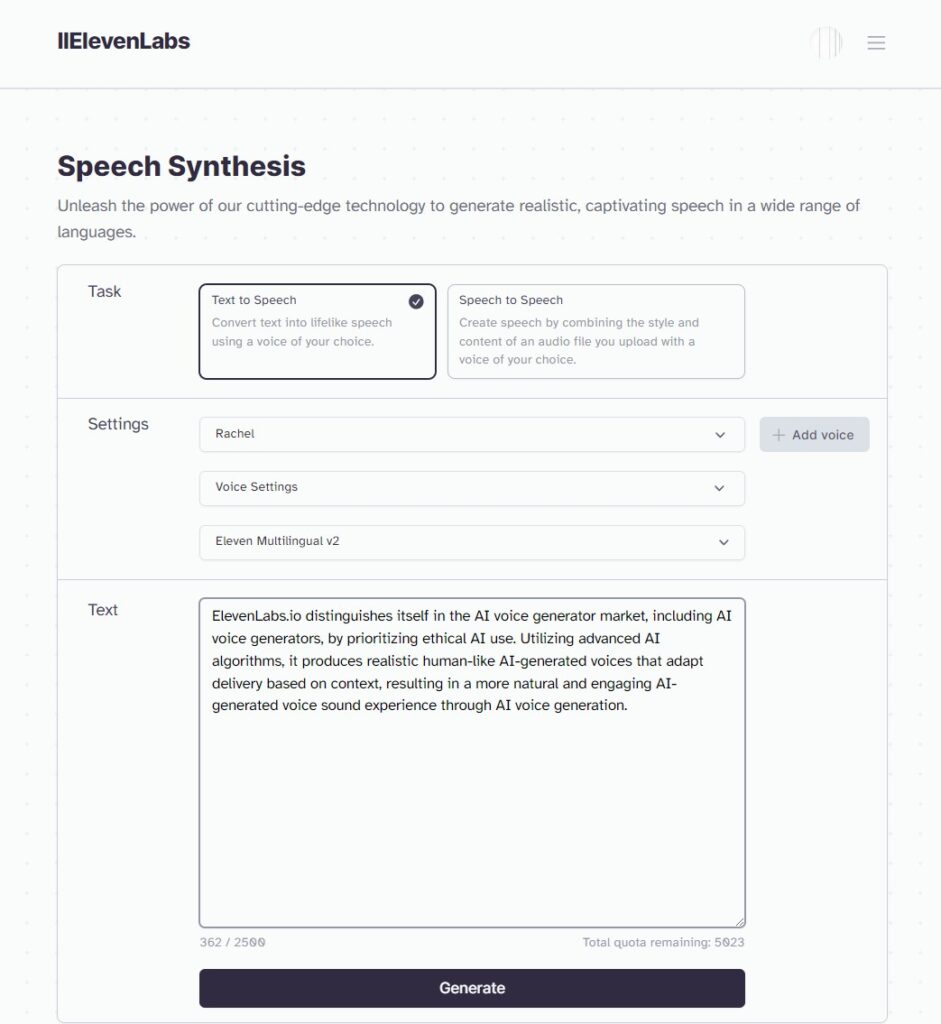
ElevenLabs: strong voice quality and a developer path

ElevenLabs combined convincing intonation with a relatively simple interface in my 2023 use. It was especially interesting for projects that might move from manual creation into an API-driven workflow. My tests were not perfect, particularly with some pronunciations and non-English material, but the naturalness of the better results raised the standard for the category.
Its current documentation separates models by quality, language coverage, latency, and long-form stability. That is a more useful way to evaluate the service than treating one sample as representative of everything it can do. ElevenLabs also states that commercial rights depend on a paid plan and on the user holding rights to the input material. Those conditions belong in the buying decision, not in the fine print after production.
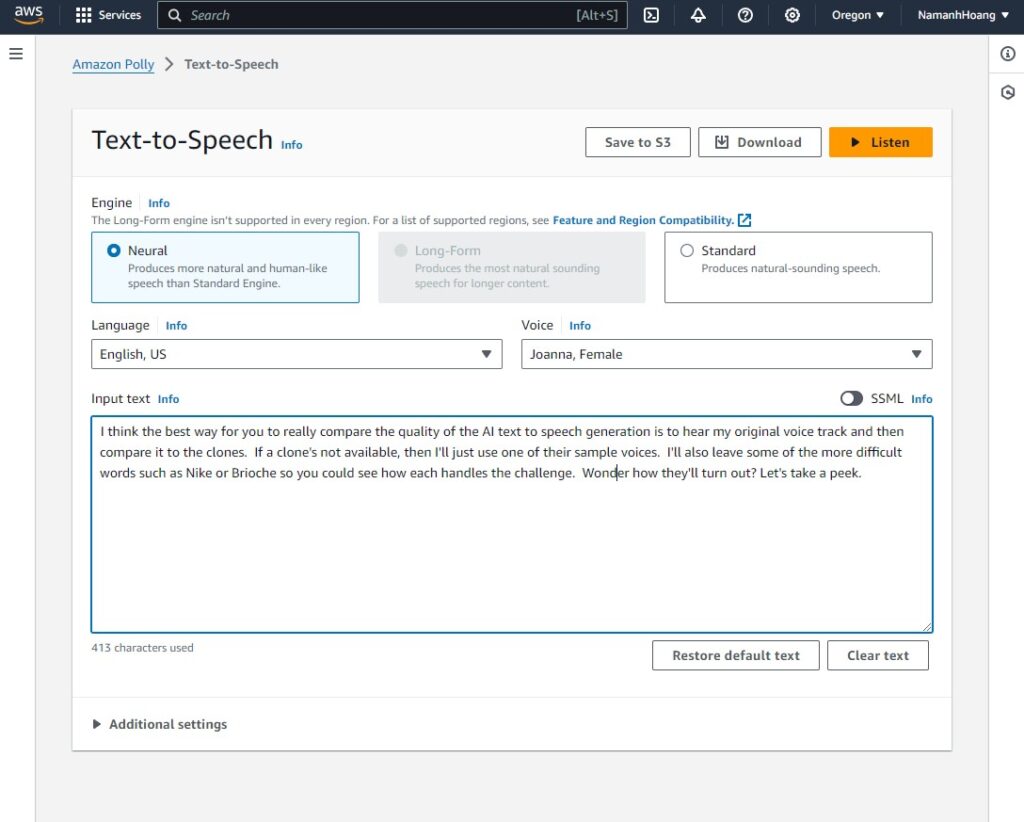
Amazon Polly: speech infrastructure rather than a creative studio

Amazon Polly was not the most emotionally nuanced option in my test. Its pacing could still reveal the machinery. What it offered was a different value proposition: usage-based speech generation inside the AWS ecosystem, with the scale and integration path that implies.
I used Polly for very long material, including audiobook experiments, without approaching the usage ceiling available to me at the time. That is dated experience, not a current price promise. AWS continues to offer Polly, but teams should calculate cost from the current voice type, character volume, region, and architecture rather than copying an old per-character number from a review.
Murf: accessible production controls, but test the delivery

Murf presented the work in a friendly studio built for creators, training, and business voiceovers. I found it easy to understand and appreciated its adjustment tools. In the original comparison, however, some voices still sounded more controlled than natural, especially when pacing and emphasis mattered.
Murf’s current product has expanded its language, API, voice-cloning, and speech-control offerings. The vendor publishes specific performance and pronunciation claims, but those are vendor benchmarks rather than substitutes for your own script test. Use a passage that includes the terminology, names, and delivery style your audience will actually hear.
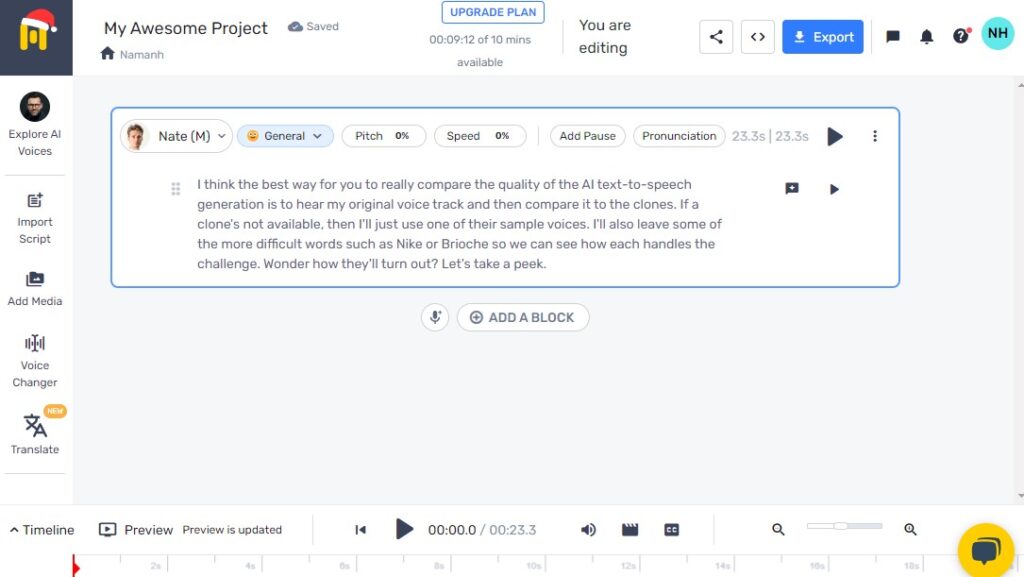
LOVO: useful pronunciation control inside a creator workflow

LOVO’s Genny interface was approachable and fit naturally into my video workflow. The pronunciation feature was particularly valuable because it addressed the problem that surfaced repeatedly across this test. I could correct a word rather than redesign the sentence around the model.
The tradeoffs I heard in 2023 included inconsistent emotional depth, occasional pronunciation issues, and slower rendering on larger files. LOVO continues to market Genny as a multilingual voice and video platform, but the current product should be tested independently. Preserve the lesson: a correction workflow can be more valuable than an impressive first-generation sample.
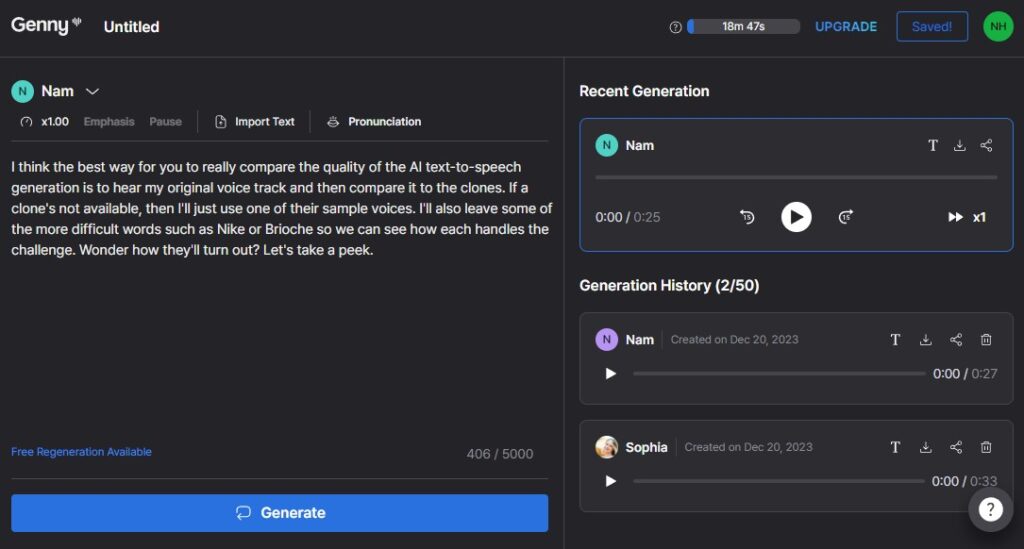
Speechify: listening and accessibility roots shape the product

Speechify entered this comparison from a different starting point. Its broader product was known for turning written material into something people could listen to, while its voiceover tools extended that capability into content production. I found it easy to use, with generally strong output, but less emotional control than I wanted for some commercial narration.
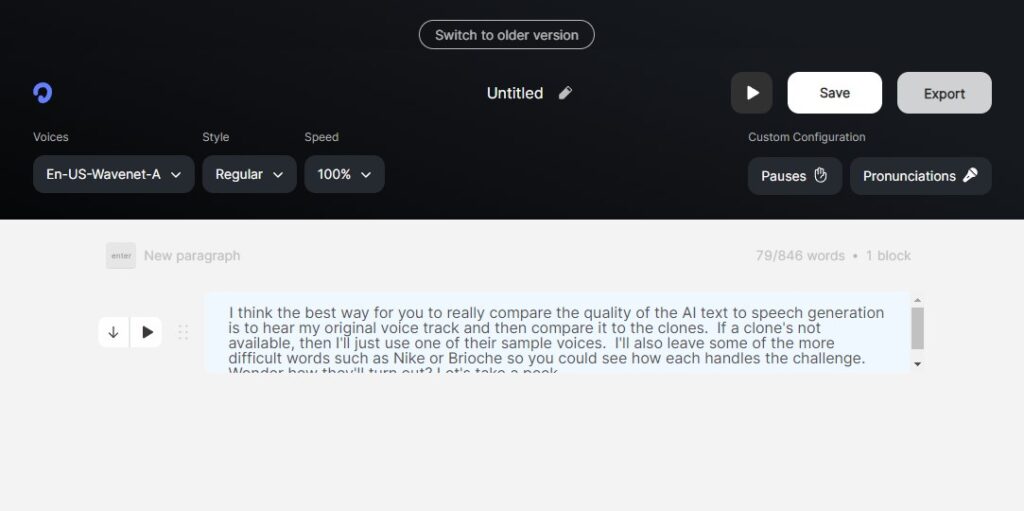
Its current AI voice generator offers a much broader production pitch than the screenshot below represents. If your primary need is reading and accessibility, evaluate that experience separately from studio voiceover. A familiar interface and a large voice catalog do not automatically answer the more important question: can the system direct a consistent performance across a complete piece?
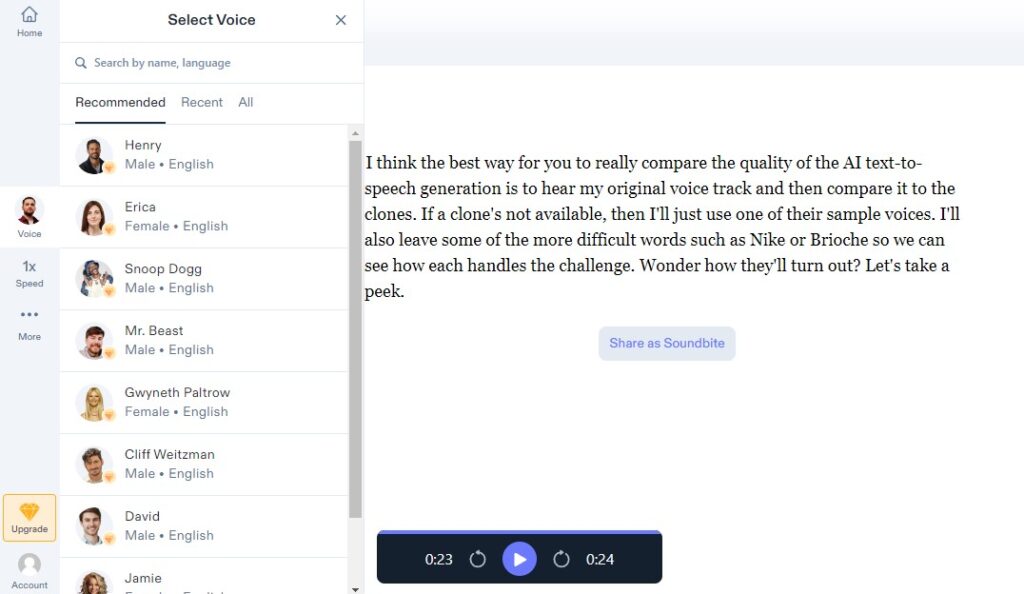
Voicemaker: granular controls for practical production

Voicemaker gave me useful control over pauses, pace, and volume without demanding much audio experience. That made it a practical option for straightforward voiceovers. The weakness was not the number of settings. It was how convincingly particular accents, regional words, and names survived the generation process.
The service remains available and continues to present a broad collection of voices and controls. Do not equate breadth with authenticity. If regional accuracy matters, have a native speaker review the result. The interface can help you refine a delivery, but it cannot decide whether that delivery respects the audience.
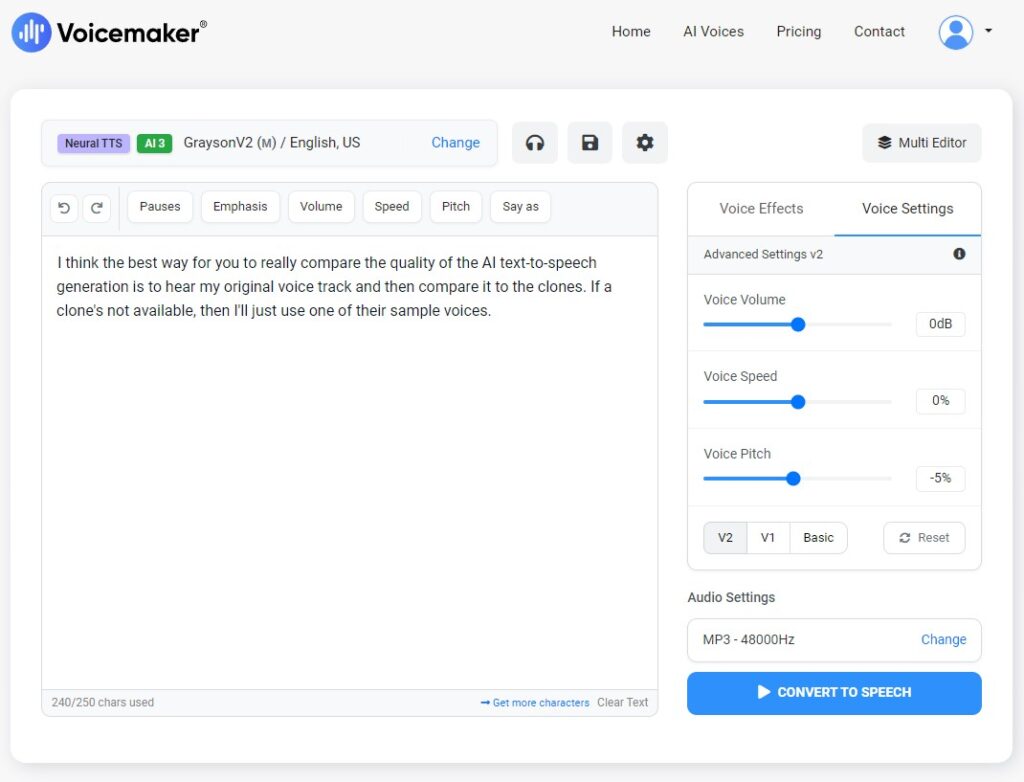
Listnr: a simple route from text to distributed audio

Listnr appealed to me because it made the path from text to audio easy to understand and connected generation with podcast-oriented workflows. The voices were improving, and the product lowered the barrier for turning written material into something publishable.
Listnr now describes a broader multilingual studio with pronunciation, speech-style, API, podcast, and commercial-use capabilities. Those are current vendor claims and should be checked against the plan and terms you intend to buy. The original sample remains useful for judging the sound I received, while the durable product question is whether generation, correction, hosting, and distribution actually belong in one workflow for your team.
Synthesys: the product has grown beyond voice generation

Synthesys was included in the original comparison as a voice platform with video and avatar capabilities. I found the interface approachable and the feature set ambitious, although upload speed, cost, and the naturalness of some avatar movement limited the experience.
By 2026, Synthesys positions itself primarily as an AI video agent that combines voice, avatars, dubbing, and multiple generation models. That shift makes the old voice-only comparison incomplete. Consider it when the deliverable is a complete video system, but compare the added automation against the control your brand actually needs. More formats do not automatically produce a better performance.
Voice cloning changes the responsibility, not only the sound
A recording is not permission. Before cloning a voice, confirm that the speaker has explicitly agreed to the intended use and understands where the synthetic output may appear. Keep the consent and the approved use in writing. Limit access to training recordings and generated files, and make deletion and offboarding part of the workflow.
Commercial terms also vary by platform and plan. Owning generated output does not grant rights to someone else’s voice, script, music, or likeness. It does not make deceptive impersonation acceptable. The FCC has confirmed that AI-generated voices fall within restrictions on artificial or prerecorded voices in robocalls, and the U.S. Copyright Office has separately examined the gaps around unauthorized digital replicas. The practical rule is simpler than the legal landscape: use voices you have a clear right to use, disclose synthetic speech when the context could mislead, and have counsel review high-risk advertising, political, financial, healthcare, or celebrity use.
How I would run the comparison today
- Use your script. Include names, numbers, acronyms, transitions, and emotional shifts that matter to the real project.
- Generate a short sample and a long one. A polished sentence does not prove consistency across ten minutes.
- Count corrections. Record how many times you rewrite, respell, regenerate, or edit the result.
- Test the workflow. Time the complete path from script change to approved export, not only the generation step.
- Have the audience review it. Native speakers and subject experts should judge localization and terminology.
- Read the current terms. Confirm commercial rights, voice consent, retention, training, and deletion for the exact plan.
The winner may differ by job. A podcast editor, localization team, accessibility product, and real-time voice agent do not need the same system. The best choice is not the voice that wins a blind demo. It is the platform that produces acceptable speech repeatedly, gives you enough control to correct it, and fits the rights and production system around the work.
Frequently asked questions
Which AI voice generator is best?
There is no defensible universal winner. Choose according to the job, then test voice quality, correction effort, workflow, integration, localization, and rights with your own material.
Can I use an AI voice commercially?
Sometimes, but the answer depends on the platform, plan, input rights, voice rights, and intended use. Read the current terms for the exact service and obtain explicit permission before cloning another person.
Does a free plan include commercial rights?
Do not assume so. Free tiers commonly restrict downloads, model access, usage volume, or commercial rights. Terms can change, which is why this article no longer publishes fixed cross-platform price ranges.
How should I test pronunciation?
Use real names, brands, acronyms, numbers, and regional terms from the project. Test whether the platform lets you save corrections rather than forcing phonetic rewrites every time.
Should synthetic speech be disclosed?
Disclose it whenever a listener could reasonably believe a real person made the recording or when the context makes identity important. Clear disclosure is especially important in advertising, endorsements, customer communications, public affairs, and any cloned-voice use.
Current product and policy sources
- Descript Regenerate and AI speech
- ElevenLabs text-to-speech documentation
- Amazon Polly
- Murf text to speech
- LOVO Genny
- Speechify AI voice generator
- Voicemaker
- Listnr
- Synthesys
- Federal Communications Commission guidance on AI-generated voices in robocalls
- U.S. Copyright Office report on digital replicas
Editorial note: Some links in this article are affiliate links. The original audio comparison and opinions were created from my own use of the products. Product capabilities and terms can change, so verify them directly before purchasing or publishing synthetic speech.